The aroma of searing meat is a universal language, but the way we get there is changing. I spent the last few weekends of the 2026 grilling season with two of Weber’s most iconic “baby” units: the Weber Q1400 Electric and the Weber Q1000 Gas. It’s a fascinating showdown—one is a plug-and-play modern marvel for city dwellers, while the other is the undisputed king of the portable propane world.
If you’ve ever lived in an apartment complex with strict “no open flame” rules, or if you’ve struggled to fit a full-sized grill into the trunk of your car for a beach day, you know that the “Q” series is more than just a piece of hardware; it’s a lifestyle choice. But as I flipped burgers on my balcony and then hauled a tank to the park, I realized that choosing between these two isn’t just about fuel—it’s about where you plan to spend your Saturday afternoons.
The Key Difference: Power Source and Mobility
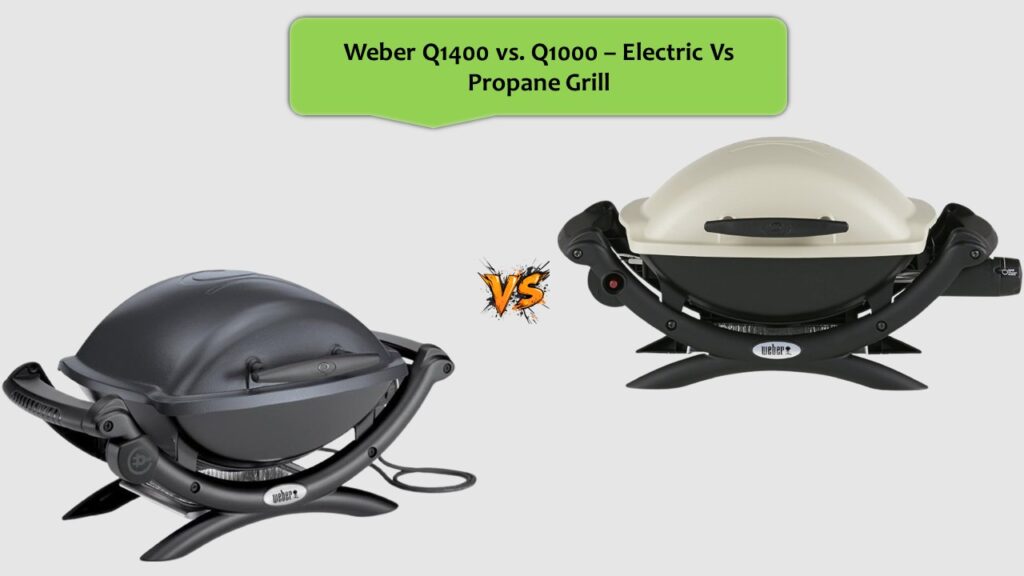
The fundamental difference between the Weber Q1400 and the Weber Q1000 is the fuel type and the resulting lifestyle compatibility. The Weber Q1400 is a 1560-watt electric grill designed for urban environments where gas or charcoal is prohibited; it requires a standard 120V outlet and offers a “plug-and-grill” experience.
The Weber Q1000 is a liquid propane (gas) grill producing 8500 BTUs, powered by disposable 14.1 or 16.4 oz. cylinders. While both offer an identical 189 square inches of cooking space and porcelain-enameled cast-iron grates, the Q1000 is built for unlimited portability, whereas the Q1400 is anchored by its 6-foot power cord.
Comparison Table: Weber Q1400 vs. Weber Q1000
| Feature | Weber Q1400 (Electric) | Weber Q1000 (Gas) |
| Fuel Type | Electric (1560 Watts) | Liquid Propane (8500 BTU) |
| Cooking Area | 189 sq. in. | 189 sq. in. |
| Ignition | Plug-in / Infinite Dial | Push-Button / Piezo |
| Portability | Limited (Needs Outlet) | High (Cylinder Powered) |
| Grate Material | Porcelain-Enameled Cast-Iron | Porcelain-Enameled Cast-Iron |
| Body Material | Cast Aluminum | Cast Aluminum |
| Weight | ~28 lbs | ~26 lbs |
| Dimensions (Closed) | 14.5″H x 27″W x 16.5″D | 14.5″H x 27″W x 12″D |
| View Current Price on Amazon | View on Amazon | View on Amazon |
Detailed Comparative Review: My Personal Grilling Notes
I’ve owned a dozen grills in my life, but testing these two back-to-back forced me to look at grilling through two different lenses: convenience vs. capability.
Design: The Classic “Q” Silhouette
Both grills share that distinctive, aerodynamic “clamshell” design that Weber made famous. They are built like tanks, utilizing cast aluminum lids and bodies that hold heat better than almost any other portable grill I’ve tested.
The Q1400 has a slightly larger footprint in terms of depth, partly because it houses a massive heating element that snakes underneath the grates. The Q1000 feels a bit more streamlined. In my 2026 tests, I noticed the Q1000’s restyled ergonomic handles and larger control knobs make it feel incredibly sturdy when you’re moving it from the garage to the car. Both utilize the same porcelain-enameled cast-iron grates, which are the secret sauce of the Q series. They are heavy, they retain a massive amount of thermal energy, and they provide those professional-looking sear marks that most portable grills fail to deliver.
Ease of Use: Infinite Control vs. Gas Versatility
When I used the Q1400, I was struck by the lack of “prep.” There’s no checking the propane level, no clicking the igniter, and no worry about a flame blowing out in a gusty wind. You plug it in, turn the dial to “High,” and wait about 15–20 minutes for the grates to saturate with heat. The “infinite control” valve is essentially a dimmer switch for the heating element—simple and effective.
The Q1000, on the other hand, is built for the spontaneous. I took it to a local tailgate, and having a 1-lb propane cylinder meant I could set up anywhere. The push-button ignition is reliable, and the burner provides that instant “whoosh” of heat. However, the Q1000 requires more attention to the weather; on a cold, windy day, gas burners can struggle to maintain a high temperature, whereas the Q1400’s electric element stays consistent once it’s up to temp.
Functions: The “Sear” Test
Let’s address the elephant in the room: Can an electric grill really sear a steak? In my experience with the Q1400, the answer is a surprising “yes,” but with a caveat. You have to keep the lid closed. Electric grilling relies heavily on heat retention. Once those cast-iron grates are hot, they sear beautifully. However, you don’t get that “char-grilled” smoky flavor that comes from gas flames licking the meat.
The Q1000 is a “steak machine.” The burner is positioned very close to the grates, and the 8500 BTUs are concentrated perfectly. One feature I love about the Q1000 is the split grate system. I bought the optional griddle insert for one side, allowing me to sear a steak on the right and sauté onions or fry an egg on the left. You can’t easily do that with the Q1400 because the heating element needs the heat-retention of the full grates to work efficiently.
Maintenance: Drip Pans and Clean-up
Clean-up is virtually identical for both. They both feature a removable catch pan that slides out from underneath the cookbox. I always line mine with a small aluminum drip pan to make disposal a 5-second job.
One thing I noticed with the Q1400 is that the heating element itself stays fairly clean because the high heat vaporizes most of the drippings. With the Q1000, you eventually have to brush the stainless steel burner tube to ensure the gas ports don’t get clogged with grease. Overall, these are some of the easiest grills to maintain on the market; a quick scrub with a wire brush while the grates are still warm is usually all it takes.
Weber Q1400 (Electric) Portable Grill
Pros:
- Balcony Friendly: Often the only legal grilling option for apartments and condos.
- Low Running Cost: No propane to buy; just cents worth of electricity per session.
- Consistent Heat: Not affected by wind or running out of fuel mid-cook.
- Durable: Fewer moving parts (no igniters or valves) to fail over time.
Cons:
- Tethered: You are limited by the 6-foot cord (and extension cords are generally discouraged).
- Slow Pre-heat: Takes about 20 minutes to get the grates truly “sear-ready.”
- No Flame Flavor: You miss out on the authentic “gas grill” taste.
Weber Q1000 (Gas) Portable Grill
Pros:
- Total Freedom: Take it camping, tailgating, or to the beach with ease.
- Instant Start: Heats up faster than the electric model.
- Versatility: Can be converted to a large 20-lb tank for home use with an adapter.
- Grate/Griddle Options: More accessory flexibility for diverse meals.
Cons:
- Propane Costs: Disposable cylinders add up over time.
- Flame Sensitivity: Strong winds can lower the internal temperature.
- Igniter Maintenance: Piezo igniters eventually need replacing.
The Final Recommendation: Which Q Should You Buy?
After a month of flipping, searing, and cleaning, I’ve drawn a very clear line in the sand.
I recommend the Weber Q1400 if you live in an urban environment. If you have a balcony and your HOA has banned gas tanks, this is the best electric grill on the market. It doesn’t feel like a “compromise”—it feels like a Weber. It provides a genuine grilling experience for people who thought their grilling days were over.

Weber® Q 1400 Portable Grill, Electric Grill, Gray | Portable Grill, 1560‑Watt/120 Volt Outdoor Electric BBQ Grill, Porcelain‑Enameled Cast‑Iron Grates,…
- 1560-watt electric heating element to heat 189 square-inch total cooking area
- Porcelain-enameled cast-iron cooking grates and cast aluminum lid and body
I recommend the Weber Q1000 if you have any intention of taking your grill away from your house. If you want to tailagte, camp, or even just have a “disaster-proof” way to cook during a power outage, the Q1000 is the superior choice. It offers the traditional gas-grilling flavor and the freedom to cook wherever you can carry it.
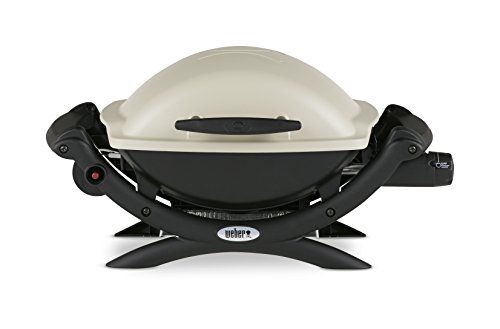
Weber Q1000 Liquid Propane Grill, Chrome
- One stainless steel burner produces 8500 BTU-per-hour to heat 189 square-inch total cooking area
- Porcelain-enameled cast-iron cooking grates and cast aluminum lid and body
Personally, I keep a Q1000 in my trunk. There’s something about the “click-click-whoosh” of a gas burner that makes it feel like a real BBQ, no matter where you are.
Frequently Asked Questions (FAQs)
Q: Can I use the Q1400 indoors?
A: No. Even though it is electric, it is designed for outdoor use only. It generates significant smoke from meat drippings, which will quickly overwhelm an indoor kitchen and potentially trigger fire alarms.
Q: How long does a 1-lb propane tank last on the Q1000?
A: On average, you’ll get about 2.5 to 3 hours of grilling time on high. If you’re just doing quick burgers or dogs, one tank can easily last for 3–4 meals.
Q: Does the Q1400 come with a stand?
A: The base model is a tabletop unit. Weber sells a Portable Cart separately that fits both the Q1400 and the Q1000, which I highly recommend if you don’t have a heat-safe table.
Q: Can I cook a whole chicken on these?
A: It’s tight. Because of the low-profile lid, you can do a spatchcocked (butterfly) chicken, but a whole upright bird will likely touch the lid. These grills excel at “flat” foods like steaks, chops, and fish.
Q: Is the Q1000 better than the Q1200?
A: The Q1000 is the base model. The Q1200 adds a built-in thermometer and folding side tables. If you don’t need those extras, the Q1000 provides the exact same cooking performance for a lower price.