The sizzle of a steak hitting a hot grate is a universal language, but for those of us living in high-rise apartments or managed condos, that language is often silenced by strict fire codes. For years, I thought “electric” meant “compromise.” However, after spending a month testing the Weber Q1400 and its larger sibling, the Weber Q2400, I’ve realized that power outlets are the new propane tanks.
These aren’t your average indoor contact grills. Weber has taken the heavy-duty cast aluminum and porcelain-enameled iron from their gas lines and paired them with a 1560-watt heating element. The result is a pair of outdoor cookers that don’t just “warm” food – they sear, crust, and roast it. While both models share the same electrical heartbeat, their physical footprints and cooking capacities create two very different grilling experiences.
After a marathon of backyard testing involving everything from delicate salmon fillets to thick-cut pork chops, I’ve broken down exactly how these two electric titans stack up when the balcony door opens and the dinner cravings hit.
The Key Difference: Weber Q1400 vs Q2400 Electric Grill
The fundamental choice between the Weber Q1400 and the Q2400 comes down to Grilling Volume and Thermal Mass.
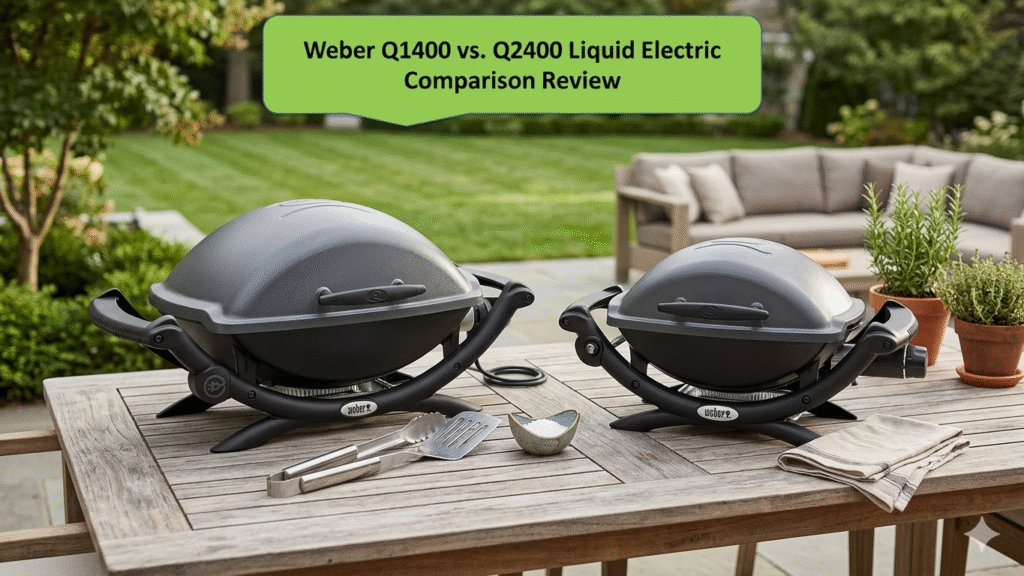
- The Weber Q1400 (The Compact Powerhouse) features a 189-square-inch cooking area. Because it uses the same 1560-watt element as the larger model but in a smaller chamber, it reaches peak searing temperatures slightly faster and is much easier to transport for a weekend getaway or a beach trip.
- The Weber Q2400 (The Family-Sized Titan) expands the horizon with 280 square inches of space. This 50% increase in room allows you to manage larger meals – think six to eight burgers at once versus the four or five you can fit on the Q1400. It also features internal heat-retention liners to help maintain those high temps across the wider surface.
In short, the Q1400 is the specialized tool for couples and solo urbanites, while the Q2400 is a legitimate primary grill for a family of four.
Comparison Table: Weber Q1400 vs. Q2400 Electric Grill
| Feature | Weber Q1400 | Weber Q2400 |
| Total Cooking Space | 189 sq. in. | 280 sq. in. |
| Heat Output | 1560 Watts / 120V | 1560 Watts / 120V |
| Grate Type | Porcelain-Enameled Cast Iron | Porcelain-Enameled Cast Iron |
| Frame Material | Glass-Reinforced Nylon | Glass-Reinforced Nylon |
| Heat Liners | Aluminum Insert | Aluminum Insert |
| Portability | Excellent (Compact) | Good (Heavier/Stationary) |
| Color Options | Gray / Dark Gray | Dark Gray |
| Ideal For | 1-3 People | 4-6 People |
| View Current Price On Amazon | View on Amazon | View on Amazon |
Detailed Comparative Review: Beyond the Plug
To really understand these grills, you have to look at how they handle the variables of outdoor cooking – wind, ambient temperature, and the sheer volume of food.
-
Design: Built to Braze
When I first lifted the lid of the Q1400, I was impressed by the “heft.” Even though it’s marketed as a portable unit, the cast aluminum body feels industrial. The rounded shape isn’t just for aesthetics; it’s designed to circulate heat like a convection oven.
The Q2400 follows the same design language but feels much more like a permanent fixture. It’s wider and deeper, giving you more “headroom” under the lid. This was a massive plus when I tried to grill thick ears of corn alongside my main course; on the Q1400, things felt a bit cramped, but the Q2400 handled the height and width with ease.

- 1560-watt electric heating element to heat 189 square-inch total cooking area
- Porcelain-enameled cast-iron cooking grates and cast aluminum lid and body

- Cooking surface 54 x 39 cm
- Up to 9 guests
-
Ease of Use: The Learning Curve
Both grills are incredibly simple to operate: plug them into a standard 120V outlet and turn the infinite control knob. However, “Electric” requires a different rhythm than gas.
- The Wait Time: On both models, I found that a 20-minute preheat is non-negotiable. You have to let the cast-iron grates absorb the heat.
- Control Precision: The infinite control burner valve is smooth and tactile. I found that on the Q1400, I could dial in a “low and slow” setting for chicken thighs that kept them juicy without scorching the skin. The Q2400 requires a bit more attention to the dial because the larger air volume inside means it reacts slightly differently to external wind.
-
Functions: The Magic of the Grate
The star of the show for both units is the split-grate system made of porcelain-enameled cast iron.
- The Sear: On the Q1400, the heat is concentrated. When I dropped a ribeye onto the center, the sizzle was immediate and aggressive. The “crust” I achieved was indistinguishable from a gas grill.
- The Zone Cooking: Because the Q2400 is wider, I was able to create “pseudo-zones.” By placing the food toward the outer edges of the heating element, I could finish thicker cuts of meat without burning the exterior. This versatility is the Q2400’s biggest functional advantage.
-
Maintenance: No Mess, No Stress
One of my favorite things about these grills is that I don’t have to deal with ash or empty propane tanks.
- Grease Management: Both models utilize a sloped bottom that funnels drippings into a removable catch pan. After a heavy session of burgers, I simply pulled out the disposable drip tray and threw it away.
- The Body: The cast aluminum won’t rust, which is a major win for coastal dwellers. I’ve left my test units out (covered, of course) through several rainstorms, and they look as good as the day I unboxed them. A quick wipe of the nylon frame with soapy water keeps them looking “showroom” fresh.
Weber Q1400 (The Apartment Icon) Propane Gas Grill
- 1560-watt electric heating element to heat 189 square-inch total cooking area
- Porcelain-enameled cast-iron cooking grates and cast aluminum lid and body
Pros:
- Fast Heat-Up: Reaches searing temps quickly due to its smaller volume.
- Storage Friendly: Easy to tuck into a corner or a storage locker.
- Durable: The cast-aluminum construction is built to last decades.
- Plug-and-Play: Perfect for balconies where gas is forbidden.
Cons:
- Small Surface: You’ll be cooking in batches if you have more than three guests.
- No Thermometer: You’ll need an external meat probe to check internal temps.
Weber Q2400 (The Patio Workhorse) Propane Gas Grill
- Cooking surface 54 x 39 cm
- Up to 9 guests
Pros:
- Family Capacity: Can easily handle a full dinner for four to six people.
- High Clearance: Deeper lid allows for larger roasts and whole chickens.
- Even Heat: Heat-retention liners ensure the large area stays hot.
- Sturdy Base: Feels like a full-sized grill once placed on a stand.
Cons:
- Heavy: At over 40 pounds, it’s not something you want to move daily.
- Power Draw: Takes up almost the entire capacity of a standard 15-amp circuit.
The Verdict: Which Weber Wins Your Kitchen?
After a month of back-to-back grilling, the “winner” really depends on the scale of your lifestyle.
I recommend the Weber Q1400 if: You are an urban dweller with limited space. If you’re cooking for one or two people and your “yard” is a 50-square-foot balcony, this is the best grill on the market. It offers premium Weber performance in a footprint that won’t crowd your outdoor furniture.
I recommend the Weber Q2400 if: You have a family or love to entertain. The 280-square-inch grate is a significant upgrade that moves this machine from “specialty appliance” to “primary grill.” If you have the room for it, the extra capacity is worth the slightly higher price and larger footprint.
My Personal Choice: I am keeping the Weber Q2400. As someone who likes to meal prep on Sundays, having the extra room to grill six chicken breasts and a pile of zucchini at the same time is a huge time-saver that the Q1400 just couldn’t match.
Frequently Asked Questions
-
Does the Q2400 get as hot as the Q1400?
Both use the same 1560-watt element. The Q1400 gets up to temperature a few minutes faster because the internal space is smaller, but once fully preheated, both grills are capable of reaching the 500°F+ range required for a proper sear.
-
Can I use these grills indoors?
No. These are strictly for outdoor use. Even though they are electric, they generate smoke and grease vapors that can be a fire hazard and an air quality issue inside a home. They are designed for balconies, patios, and decks.
-
How do I clean the cast-iron grates?
The best way is to “burn off” any residue after you’re done cooking. Turn the grill to high for 10 minutes with the lid closed, then use a stainless steel grill brush to sweep away the carbonized remains. Never soak the grates in water for long periods, as this can encourage rust if the porcelain coating is chipped.
-
What happens if I trip a breaker?
If the grill shuts off, it’s likely because you have another high-draw appliance (like a toaster or an AC unit) on the same circuit. These grills pull nearly 13 amps. Try to use a dedicated outlet or ensure no other major appliances are running on that line while you’re grilling.
-
Do they come with a stand?
No, the base units are tabletop models. Weber sells a separate “Q-Stand” or “Portable Cart” that fits both the Q1400 and Q2400 perfectly if you don’t have a sturdy table available on your patio.