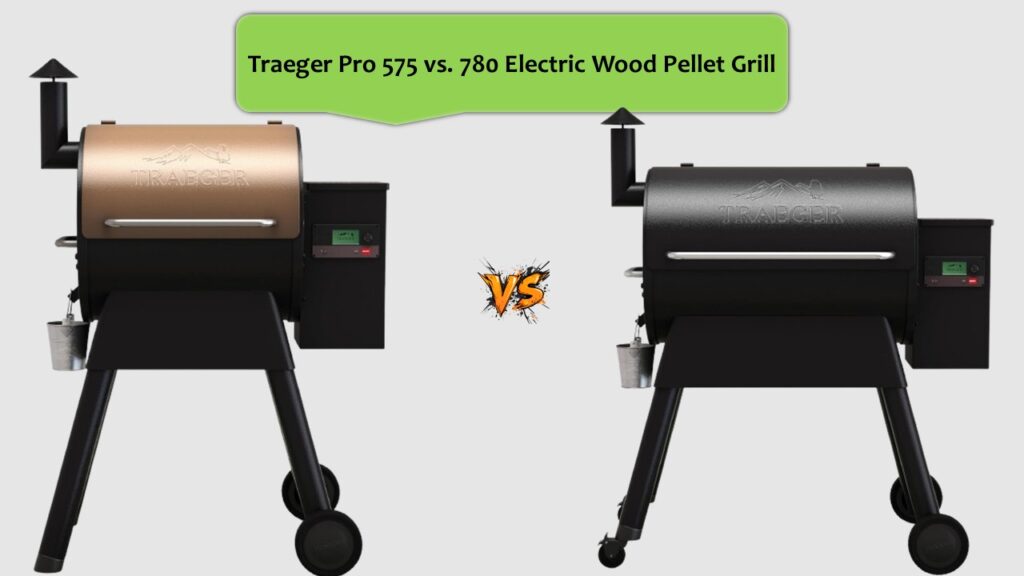
Stepping out onto the patio on a Saturday morning in 2026, there’s a specific sequence of sounds that signals the start of a great weekend: the rustle of a heavy-duty grill cover being pulled back, the metallic clatter of wood pellets hitting the hopper, and that distinct, futuristic chirp of a Traeger controller connecting to the home Wi-Fi. Over the last month, I’ve had the unique pleasure (and the resulting “meat sweats”) of running the Traeger Pro 575 and the Traeger Pro 780 side-by-side.
These two units are essentially the “iPhone 15” and “iPhone 15 Plus” of the pellet grill world. They share the same high-tech DNA, the same lightning-fast D2 drivetrain, and the same incredibly addictive app interface. But as I found out while trying to cram enough ribs for a neighborhood block party onto the grates, that extra bit of “real estate” on the 780 isn’t just a luxury – it changes how you plan your entire cook. If you’re standing in the aisle wondering if those extra square inches are worth the jump in price and footprint, I’ve spent enough time scrubbing these porcelain grates to give you the honest, grease-covered truth.
The Key Difference: Capacity vs. Footprint
The fundamental difference between the Traeger Pro 575 and the Pro 780 is the total cooking surface area and physical dimensions. Both grills utilize the identical D2 Direct Drive Drivetrain, WiFIRE technology, and TurboTemp software.
However, the Traeger Pro 780 offers 780 square inches of cooking space, which is roughly 35% more than the 575 square inches found on the Pro 575. To accommodate this larger grate, the Pro 780 is 8 inches wider and nearly 20 pounds heavier than the 575. In short: they are technologically identical, but the Pro 780 is a high-capacity machine for large groups, while the Pro 575 is a space-saving powerhouse for the average family.
Comparison Table: Traeger Pro 575 vs. Pro 780 Wood Pellet Grill
| Feature | Traeger Pro 575 | Traeger Pro 780 |
| Cooking Space | 575 sq. in. | 780 sq. in. |
| Burger Capacity | 24 Burgers | 34 Burgers |
| Chicken Capacity | 4 Whole Chickens | 6 Whole Chickens |
| Drivetrain | D2 Direct Drive (Brushless) | D2 Direct Drive (Brushless) |
| Connectivity | WiFIRE (Wi-Fi App Control) | WiFIRE (Wi-Fi App Control) |
| Width | 41 Inches | 49 Inches |
| Weight | 149 lbs | 166.6 lbs |
| Temperature Range | Up to 500°F | Up to 500°F |
| Meat Probe | Included (1 port) | Included (1 port) |
| View Current Price on Amazon | View on Amazon | View on Amazon |
Detailed Comparative Review: My Personal Experience in the Smoke
Testing these was less about comparing “quality” – since they are built almost identically – and more about how they fit into the flow of my life over thirty days.
Design: The Sawhorse Chassis and Build Quality
Both grills sport that rugged, industrial Traeger look that I’ve grown to love. The sawhorse chassis is incredibly stable; I never felt like either grill was going to tip, even when I was aggressively scrubbing the grates. The Pro 575 has a lovely, compact feel to it. It tucked into the corner of my deck perfectly, leaving plenty of room for my patio table.
The Pro 780 is a different beast. It feels much wider in person than the specs suggest. Those extra 8 inches of width make it look like a “professional” rig. The heavy-duty wheels on both models handled my stone patio and the occasional patch of grass with ease, but the 780 definitely requires more muscle to pivot. One thing I noticed: the Pro 575 in Bronze has a classic, premium look, while the Black 780 looks like a sleek piece of modern tech. Both use the same high-quality alloy steel, and after a few rainstorms (with covers on), they still look brand new.
Ease of Use: The Magic of WiFIRE and D2
This is where both grills shine and why I’ve become a bit of a Traeger evangelist this year. The D2 Drivetrain means they both heat up incredibly fast. I was hitting 450°F in under 15 minutes, which is faster than my old gas grill used to reach searing temps. The brushless motor is surprisingly quiet – I could sit five feet away and have a conversation without that annoying “drone” some older smokers have.
The WiFIRE app is the same on both, and it is a game-changer. I was able to go to the grocery store while my pork butt was at the 6-hour mark, and I could check the internal temp on my phone while standing in the checkout line. If the 780 ran low on pellets (thanks to the 18lb hopper), it let me know. The TurboTemp feature on both units is stellar; when I opened the lid to mop my ribs, both grills recovered their target temperature within a couple of minutes. The “ease of use” is identical here – it’s flawless.
Functions: 6-in-1 Versatility at Different Scales
I put the 6-in-1 versatility to the test on both. I’ve smoked briskets, baked wood-fired pizzas, and even roasted a whole spatchcock chicken.
The Pro 575 is plenty for a family of four. I was able to fit 5 racks of ribs using a rib rack, which was more than enough. However, when I invited the neighbors over, I felt the “squeeze.” On the Pro 780, I could spread out 6 whole chickens with room to breathe. The convection airflow is great on both, but because the 780 has more internal volume, I felt like the air circulated a bit more freely when the grill was fully loaded, resulting in slightly more even browning on the edges.
Maintenance: The Cleaning Ritual
Cleaning a pellet grill is never “fun,” but Traeger has made it as painless as possible. Both units have a straightforward grease management system where the drippings run down a tray into a bucket on the side. I highly recommend the foil liners – they save about 20 minutes of scraping.
The Pro 575 is slightly easier to vacuum out just because the firepot is easier to reach without leaning too far into the barrel. The Pro 780 has more surface area to wipe down, but since the parts are identical in material, the experience is the same. Just a tip from my month of testing: vacuum out the firepot every 2-3 cooks. It keeps that D2 motor running at peak efficiency and prevents any flame-outs.
Traeger Pro 575 Electric Wood Pellet Grill
Pros:
- Space-Saving: Perfect for smaller decks or balconies.
- Price Value: You get all the elite D2 and WiFIRE tech at a lower entry price.
- Efficiency: Heats up slightly faster due to the smaller internal volume.
- Maneuverability: Much easier to move and store solo.
Cons:
- Limited for Crowds: You’ll struggle to fit more than 5 racks of ribs or a massive brisket and sides.
- Hopper Size: Smaller barrel means you have to be more careful with pellet levels on long overnight smokes.
Traeger Pro 780 Electric Wood Pellet Grill
Pros:
- Massive Capacity: Easily feeds 10-15 people without breaking a sweat.
- Presence: It looks and feels like a professional smoker.
- Better Airflow: More room for smoke to circulate around large quantities of meat.
- Crowd Pleaser: Fits 34 burgers – you’ll be the hero of the neighborhood BBQ.
Cons:
- Heavy: At 166 lbs, it’s a workout to move.
- Footprint: Requires nearly 5 feet of horizontal space.
- Cost: You’re paying a premium strictly for the extra steel and grate space.
The Final Recommendation: Which Pro Belongs in Your Backyard?
After a month of back-to-back testing, the “best” grill isn’t the biggest one – it’s the one that fits your life.
I recommend the Traeger Pro 575 if you are primarily cooking for a family of 4 to 6 people. It has every bit of the high-end technology found in the larger model but in a package that won’t dominate your patio. If you value deck space and don’t plan on hosting the entire soccer team for dinner, the 575 is the smarter, more efficient buy.

- WiFIRE Technology for Remote Control: Monitor and control your electric smoker and grill from...
- Included Meat Probe and All-Terrain Mobility: Monitor internal food temps without lifting the...
I recommend the Traeger Pro 780 if you are the designated “party house.” If you find yourself frequently cooking for groups of 8 or more, or if you like to “meal prep” by smoking 6 chickens at once on a Sunday, the 780 is worth the extra investment. You can never have too much grill space, but you can definitely have too little.

- Smart Grilling with WiFIRE technology: Control your electric smoker grill from anywhere with...
- Temperature Control with D2 Drivetrain: The upgraded D2 controller and brushless motor bring...
Personally, I found myself leaning toward the Pro 780. There’s a peace of mind that comes with knowing I can fit a full brisket, a tray of beans, and a pan of cornbread all at the same time without playing “tetris” with the grates.
Frequently Asked Questions (FAQs)
Q: Is the WiFIRE technology hard to set up?
A: Not at all. In 2026, the app is incredibly refined. It took me about 5 minutes to connect both grills to my home network. Just make sure your Wi-Fi signal reaches your patio!
Q: Can I use other brands of pellets in these grills?
A: Traeger recommends their own pellets to ensure the warranty remains valid and the auger doesn’t jam. I’ve found that Traeger pellets are more consistent in size, which is important for the D2 Drivetrain.
Q: Do these grills sear steaks well?
A: They reach 500°F, which is plenty for a good sear. However, because they are convection-based, you won’t get the same direct-flame char as a gas or charcoal grill. I recommend a cast-iron skillet on the grate for the perfect crust.
Q: How much power do they use?
A: They are very efficient. They use a bit of power during the “glow plug” ignition phase, but once the fire is going, they use about as much electricity as a standard light bulb to run the fan and auger.
Q: Can I leave them outside in the winter?
A: Yes, the alloy steel and powder coating are built for all seasons. However, the electronics will thank you if you use a dedicated Traeger cover to keep the moisture out.