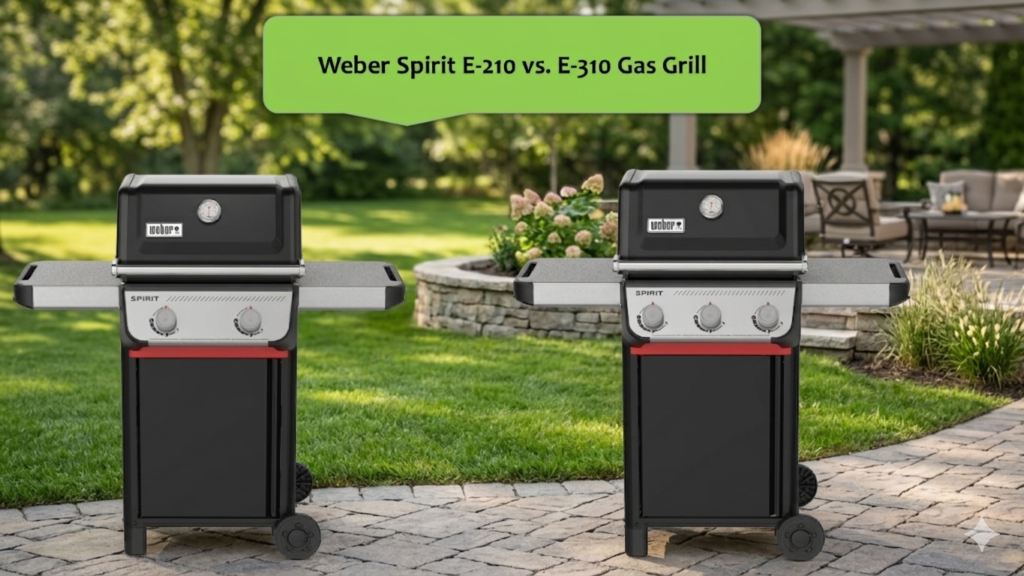
Walking into a showroom full of gleaming black hoods and stainless steel accents can be overwhelming, but for most backyard cooks, the search eventually narrows down to the “Goldilocks” of the grilling world: the Weber Spirit series. Specifically, the battle usually pits the Weber Spirit E-210 against its slightly larger sibling, the Weber Spirit E-310.
I’ve spent countless weekends rotating between these two models, treating my patio like a laboratory for charred protein and caramelized vegetables. These grills are the entry point into the premium Weber experience, sitting just below the more expensive Genesis line. They offer the same industrial build quality – cast-aluminum cook boxes, porcelain-enameled cast-iron grates, and the legendary Flavorizer Bars – but they serve very different masters.
One is a master of the small-space “indirect” roast, while the other is a high-capacity machine built for those who never want to run out of “real estate” during a neighborhood BBQ. If you are struggling to decide if that third burner is worth the extra investment, I’ve stripped away the marketing jargon to share how these machines actually behave when you’re trying to time a perfect medium-rare ribeye.
The Key Difference: Weber Spirit E-210 vs. E-310 Grill
The fundamental divergence between the Weber Spirit E-210 and the E-310 comes down to Surface Area and Zonal Control.
- The Weber Spirit E-210 (The Compact Specialist) features 2 stainless steel burners. Because it is narrower, it fits perfectly on apartment balconies or small patios. However, having only two burners means your “indirect” cooking zone is more limited – you basically have a left side and a right side.
- The Weber Spirit E-310 (The Three-Burner Workhorse) steps up to 3 stainless steel burners. This third burner is a game-changer for versatility. It allows you to create a “true” indirect heat zone in the center of the grill by turning off the middle burner while the two outside burners provide ambient heat. It also offers a larger primary cooking area for bigger families.
Essentially, the E-210 is the king of efficiency and small-footprint grilling, while the E-310 is the choice for the “culinary purist” who wants more precise control over heat zones and larger meal capacities.
Comparison Table: Weber Spirit E-210 vs. E-310 Grill
| Feature | Weber Spirit E-210 | Weber Spirit E-310 |
| Burner Count | 2 Stainless Steel Burners | 3 Stainless Steel Burners |
| Ignition System | Snap-Jet Electronic | Snap-Jet Electronic |
| Grate Material | Porcelain-Enameled Cast Iron | Porcelain-Enameled Cast Iron |
| Cook Box Material | Cast Aluminum (Rust-Resistant) | Cast Aluminum (Rust-Resistant) |
| Side Tables | 2 Hammertone Metal Tables | 2 Hammertone Metal Tables |
| Tank Storage | Enclosed Cabinet | Enclosed Cabinet |
| Warranty | 10-Year Limited | 10-Year Limited |
| Tool Hooks | 4 Integrated Hooks | 4 Integrated Hooks |
| View Current Price On Amazon | View on Amazon | View on Amazon |
Detailed Comparative Review: Searing with the Spirits
To truly appreciate the nuances of these machines, you have to look past the spec sheets and consider the flow of a real-world cookout. It’s one thing to talk about BTU output, but it’s another to manage a dozen burgers while simultaneously toasting buns on the warming rack.
-
Design: The Architecture of the Cook Box
When I first fired up the Spirit E-210, I was struck by its “urban” design. It’s a sturdy, handsome machine that manages to feel substantial without being bulky. The cast-aluminum cook box is the hero here; it holds heat like a vault and, unlike cheaper steel cook boxes, it won’t rust or peel over time. The “hide the tank” cabinet design keeps the patio looking tidy, which I appreciated when I was grilling in a more visible part of the yard.
The Spirit E-310 shares that same rugged DNA but feels more like a “permanent station.” The wider frame gives you more elbow room, and the Hammertone metal side tables are surprisingly scratch-resistant. I found that the E-310’s wider stance made it feel more stable when rolling it across my uneven patio pavers. Both grills feature the “Weber Works” side rails, which allowed me to snap on a bottle holder – a small detail that becomes very important during a long July afternoon.

Weber® Spirit® E-210 Gas Grill, Outdoor Cooking, Small Propane Grill, Black | Weber® Grill 2 Burners, Porcelain-Enameled Cast-Iron Grates, Snap-Jet…
- The Black Weber Spirit E-210 Grill has a 10-year limited warranty; Weber Works side rails fit snap-on accessories (sold separately) such as a Bottle Holder, extra Tool Hooks, and Flexible Lighting to give you more room at the grill
- Precise, Consistent Heat: Outdoor propane grill gets to temp quickly and cooks food evenly across the grates; Porcelain-enameled, cast-iron grates retain heat evenly, are easy to clean, and built to last

Weber® Spirit E-310 Gas Grill, Outdoor Cooking, Small Propane Grill, Black | 3 Burners, Porcelain-Enameled Cast-Iron Grates, Snap-Jet Ignition, Weber…
- The Black Weber Spirit E-310 Grill has a 10-year limited warranty; Weber Works side rails fit snap-on accessories (sold separately) such as a Bottle Holder, extra Tool Hooks, and Flexible Lighting to give you more room at the grill
- Precise, Consistent Heat: Outdoor propane grill gets to temp quickly and cooks food evenly across the grates; Porcelain-enameled, cast-iron grates retain heat evenly, are easy to clean, and built to last
-
Ease of Use: One-Handed Ignitions
Weber’s Snap-Jet Ignition is one of those features that ruins other grills for you. I loved the fact that I could simply press and turn a single knob with one hand to get things started. On both the E-210 and E-310, the ignition was nearly instantaneous every time, regardless of the humidity.
The control knobs on the E-310 offer a bit more “tactical” satisfaction. Because you have three knobs to play with, you can really fine-tune the temperature gradient. On the E-210, I found myself having to be a bit more strategic with food placement since I only had two main heat sources. If you’re a beginner, the E-210 is perhaps more “forgiving” because there are fewer variables, but the E-310 is the one you grow into as a cook.
-
Functions: Flavorizers and Indirect Magic
This is where the third burner on the E-310 earns its keep.
- The Flavorizer Bars: Both models use stainless steel Flavorizer bars. I watched as the drippings from my burgers hit these bars and instantly vaporized into a puff of smoke. That “grill flavor” isn’t coming from the gas; it’s coming from those vaporized juices, and both models do an excellent job of funneling the excess grease away from the burners to prevent flare-ups.
- Indirect Roasting: I attempted a whole roasted chicken on both. On the E-310, it was a breeze – I turned off the middle burner and let the two side burners do the work. The chicken came out perfectly juicy with crispy skin. On the E-210, I had to push the chicken all the way to one side and use only the opposite burner. It worked, but I had to rotate the bird halfway through to ensure an even cook. For “low and slow” enthusiasts, the E-310 is the clear winner.
-
Maintenance: The “Quick-Slide” Grease System
Cleanup is usually the part of grilling I dread, but the Grease Management System on the Spirit series is a masterclass in common sense.
- Cleaning the Spirits: Both units have a front-access grease tray that slides out like a drawer. I could swap out the disposable drip pan in seconds.
- Grate Care: The porcelain-enameled cast-iron grates are remarkably slick. After a heavy session with sticky BBQ sauce, I just cranked the heat to high for 10 minutes, gave them a quick brush, and they were ready for the next round. I didn’t find one easier to clean than the other, though the E-310 obviously has more surface area to brush down.
Weber Spirit E-210 (The Compact Icon) Grill
Weber® Spirit® E-210 Gas Grill, Outdoor Cooking, Small Propane Grill, Black | Weber® Grill 2 Burners, Porcelain-Enameled Cast-Iron Grates, Snap-Jet…
- The Black Weber Spirit E-210 Grill has a 10-year limited warranty; Weber Works side rails fit snap-on accessories (sold separately) such as a Bottle Holder, extra Tool Hooks, and Flexible Lighting to give you more room at the grill
- Precise, Consistent Heat: Outdoor propane grill gets to temp quickly and cooks food evenly across the grates; Porcelain-enameled, cast-iron grates retain heat evenly, are easy to clean, and built to last
Pros:
- Space-Saving: Perfect for small decks, balconies, or tight patios.
- Efficiency: Gets to temperature incredibly fast with only two burners.
- High-End Build: Same 10-year warranty and cast-aluminum box as the bigger models.
- Cost-Effective: A more accessible entry point into the Weber ecosystem.
Cons:
- Limited Heat Zones: Harder to manage complex indirect cooking.
- Lower Capacity: You’ll be cooking in shifts if you have more than 4-5 guests.
Weber Spirit E-310 (The Family-Sized Workhorse) Grill
Weber® Spirit E-310 Gas Grill, Outdoor Cooking, Small Propane Grill, Black | 3 Burners, Porcelain-Enameled Cast-Iron Grates, Snap-Jet Ignition, Weber…
- The Black Weber Spirit E-310 Grill has a 10-year limited warranty; Weber Works side rails fit snap-on accessories (sold separately) such as a Bottle Holder, extra Tool Hooks, and Flexible Lighting to give you more room at the grill
- Precise, Consistent Heat: Outdoor propane grill gets to temp quickly and cooks food evenly across the grates; Porcelain-enameled, cast-iron grates retain heat evenly, are easy to clean, and built to last
Pros:
- 3-Burner Versatility: The center burner allows for professional-level indirect roasting.
- Large Cooking Area: Plenty of room for 12-15 burgers at once.
- Better Heat Control: More knobs mean more precision across the grates.
- Stable Presence: A wider, more “professional” feel on the patio.
Cons:
- Larger Footprint: Takes up significantly more horizontal space.
- Propane Usage: Naturally consumes fuel faster if all three burners are engaged.
The Verdict: Which Spirit Should You Bring Home?
After months of back-to-back testing, the “best” grill is determined by the size of your guest list and your ambition for indirect cooking.
I recommend the Weber Spirit E-210 if: You are a couple or a small family living in an urban environment. If your “backyard” is a balcony or a small patio, the E-210 is a world-class machine that won’t make your space feel cluttered. It delivers the exact same searing power and durability as the larger model in a more efficient package.
I recommend the Weber Spirit E-310 if: You host more than four people regularly or if you want to experiment with roasting whole chickens and ribs. The third burner is not a luxury; it is a functional necessity for “low and slow” BBQ. If you have the space on your deck, the E-310 is the most versatile gas grill in its class.
My Personal Choice: I am sticking with the Weber Spirit E-310. The ability to turn off that middle burner for indirect roasting has completely changed how I use my grill, moving it from a “burger machine” to a legitimate outdoor oven.
Frequently Asked Questions
-
Does the 3rd burner really make a difference for heat?
Yes, but not just in “max heat.” Both grills can reach 500°F+ easily. The 3rd burner is about distribution. In the E-310, you have more even heat across the entire grate, whereas the E-210 has a small “gap” in the very center between the two burner tubes.
-
Is the “10-Year Limited Warranty” actually good?
It is industry-leading for this price point. It covers the cook box and lid assembly for a full decade against rust or burn-through. This is why people buy Weber; you aren’t just buying a grill for two summers, you’re buying it for a decade.
-
Can I use these with Natural Gas?
These specific models are designed for Liquid Propane. Weber does make Natural Gas versions of the Spirit series, but you must buy the specific NG model – you cannot simply “convert” a propane grill with a kit without voiding the warranty and risking safety.
-
Are the Flavorizer Bars stainless steel?
Yes. Unlike the porcelain-coated steel bars found on cheaper grills, the stainless steel Flavorizer bars on the Spirit series are designed to withstand the intense heat and corrosive drippings of a BBQ session without rusting out in one season.
-
Do the side tables fold down?
On the E-210, the side tables do fold down, which is a massive win for storage. On the E-310, the tables are fixed to provide better stability for the larger frame. Keep this in mind if you have a very narrow storage area!