There is a specific kind of freedom that comes with a portable gas grill. It’s the ability to turn a trailhead, a beach, or a stadium parking lot into a five-star steakhouse in under twenty minutes. For years, the Weber Q series has dominated this “go-anywhere” category, but choosing between the stripped-down Weber Q1000 and the feature-heavy Weber Q2200 is a dilemma every outdoor enthusiast eventually faces.
I’ve spent the last month living out of my trunk and cooking on both. These machines share the same legendary DNA – thick cast-aluminum lids that hold heat like a vault and heavy porcelain-enameled cast-iron grates that produce professional-grade sear marks. But as I moved from flipping quick hot dogs for a crowd to trying to roast a delicate salmon fillet in a windy campsite, the personality of each grill started to emerge.
One is a lightweight, “no-nonsense” searing machine built for speed and mobility. The other is a sophisticated, small-scale outdoor oven designed for the cook who refuses to sacrifice precision just because they’re away from home. Here is how they actually stack up when the sun starts to set and the hunger kicks in.
The Key Difference: Weber Q1000 vs. Q2200 Gas Grill
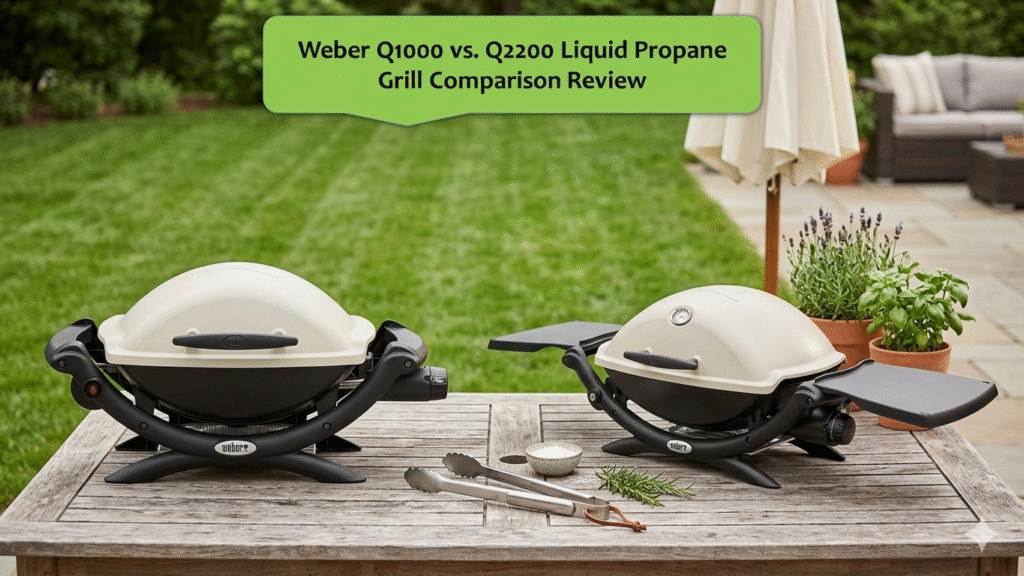
The fundamental divide between the Weber Q1000 and the Q2200 comes down to Chamber Volume, Integrated Prep Space, and Scientific Accuracy.
- The Weber Q1000 (The Lightweight Specialist) is built for the minimalist. It offers 189 square inches of cooking area and an 8,500 BTU It is designed to be as small and light as possible, which means it lacks side tables and a built-in thermometer. It’s a “guess-and-check” grill that rewards experienced cooks who know their heat by feel.
- The Weber Q2200 (The Deluxe Overlander) is a significantly more “complete” kitchen tool. It expands the cooking area to 280 square inches and boosts the burner to 12,000 BTUs. Crucially, it includes two folding side tables for prep work and a lid-mounted thermometer for precise temperature management. It also features a taller lid, which is the difference between grilling a flat burger and roasting a whole, upright chicken.
Essentially, the Q1000 is a “grab-and-go” tool for solo travelers and couples, while the Q2200 is a portable patio replacement capable of feeding a family of four without breaking a sweat.
Comparison Table: Weber Q1000 vs. Q2200 Gas Grill
| Feature | Weber Q1000 | Weber Q2200 |
| Cooking Surface | 189 sq. in. | 280 sq. in. |
| Burner Power | 8,500 BTU/hr | 12,000 BTU/hr |
| Ignition System | Push-Button Piezo | Continuous Electronic |
| Work Tables | None | 2 Side-Folding Tables |
| Thermometer | External Required | Built-in Lid Gauge |
| Lid Clearance | Standard | High-Profile |
| Unit Weight | 28.5 lbs | 44 lbs |
| Construction | Cast Aluminum | Cast Aluminum |
| View Current Price on Amazon | View on Amazon | View on Amazon |
Detailed Comparative Review: The Griller’s Perspective
Living with these grills on the road reveals the small ergonomic details that a spec sheet simply can’t capture. It’s one thing to look at BTU numbers; it’s another to try and prep a salad on a picnic table that’s already covered in gear.
-
Design: Portability vs. Stability
The Q1000 is a marvel of industrial design. It feels like a solid block of aluminum. Because it lacks tables and extra sensors, there is very little that can break or rattle when it’s bouncing around in the back of a truck. The ergonomic side handles are wide and comfortable, making it easy to carry from the car to the picnic site in one hand.
The Q2200 is noticeably larger and heavier. At 44 pounds, it’s a commitment to move. However, once it’s set up, the folding side tables change the entire dynamic of the cookout. They are made of a rigid, glass-reinforced nylon that doesn’t flex, giving me a reliable place to set my seasonings and tongs. The tall lid also gives the grill a much more “pro” look, providing enough vertical clearance to roast bulky items that would never fit under the Q1000’s hood.
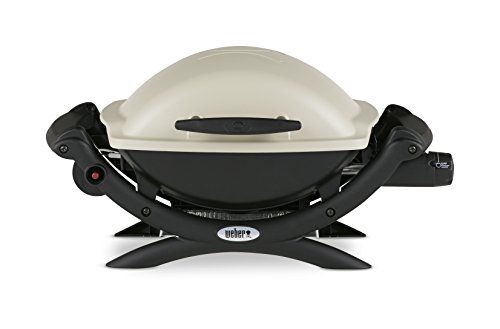
Weber Q1000 Liquid Propane Grill, Chrome
- One stainless steel burner produces 8500 BTU-per-hour to heat 189 square-inch total cooking area
- Porcelain-enameled cast-iron cooking grates and cast aluminum lid and body

Weber Q2200 Liquid Propane Grill, Gray
- Total cooking area = 280 Square Inches
- Stainless steel burner
-
Ease of Use: Ignition and Monitoring
There is a distinct “quality of life” jump when moving from the 1000 to the 2200.
- The Ignition: The Q1000 uses a manual “click” igniter that works well but can be finicky in high humidity. The Q2200 uses a battery-powered electronic ignition that clicks rapidly the moment you hold the button down. It feels much more like a high-end home grill.
- Temperature Tracking: I found that cooking on the Q1000 requires more focus. Since there is no thermometer, I had to keep the lid closed and “trust the process.” With the Q2200, the built-in thermometer allowed me to dial in a perfect 375°F for indirect roasting – a level of precision that is rare in the portable category.
-
Functions: The Searing Performance
Despite the difference in BTUs, both grills utilize the same porcelain-enameled cast-iron grates, which are the true secret to the Weber Q’s success.
- Searing Power: The Q1000 is a “concentrated” heater. Because the chamber is smaller, the 8,500 BTUs make those grates incredibly hot, incredibly fast. It is a burger-searing machine.
- Versatility: The Q2200 is more of a “convection” heater. The 12,000 BTUs cover the larger area effectively, and the extra headspace allows for better air circulation. I used the “split-grate” design to pop in a griddle (sold separately) on the Q2200 and made a full batch of pancakes and bacon for my group – a feat that would have been a cramped nightmare on the smaller Q1000.
-
Maintenance: Built to Last
Cleanup is the area where Weber really shines. Both models use a sloped floor that funnels grease into a removable catch pan.
I found that because the Q2200 has more surface area, it naturally takes a bit longer to brush down after a big meal. However, the cast aluminum body on both is virtually immune to the rust and “peeling” that plagues cheaper steel portable grills. A quick wipe of the exterior with a damp cloth was usually all I needed to keep both units looking brand new after a week in the woods.
Weber Q1000 (The Minimalist Master) Gas Grill
Weber Q1000 Liquid Propane Grill, Chrome
- One stainless steel burner produces 8500 BTU-per-hour to heat 189 square-inch total cooking area
- Porcelain-enameled cast-iron cooking grates and cast aluminum lid and body
Pros:
- Ultra-Light: Easy for one person to move, even over long distances.
- Small Footprint: Fits on the tiniest balconies or in packed trunks.
- Indestructible: Very few moving parts to wear out.
- Fast Pre-Heat: Reaches searing temps in under 10 minutes.
Cons:
- No Prep Space: You are at the mercy of your environment for table space.
- No Thermometer: Harder to master for beginners or complex recipes.
Weber Q2200 (The Portable Chef) Gas Grill
Weber Q2200 Liquid Propane Grill, Gray
- Total cooking area = 280 Square Inches
- Stainless steel burner
Pros:
- Integrated Tables: Provides a clean workspace wherever you go.
- Precision Cooking: Lid thermometer takes the guesswork out of grilling.
- High Capacity: Can comfortably feed a family of four or five.
- Tall Lid: Essential for roasting chickens or large cuts of meat.
Cons:
- Heavy: At 44 lbs, it’s a “two-hand” carry for most people.
- Space Hog: Requires a much larger storage area than the Q1000.
The Verdict: Which Q Should You Pack?
After a month of “on-the-road” grilling, my recommendation is based on your Group Size and Setup.
I recommend the Weber Q1000 if: You are a solo camper, a couple, or someone who primarily grills high-heat items like steaks and burgers. If you have limited storage space and need a grill that is truly “grab-and-go,” the Q1000 is the best-engineered small grill on the planet.
I recommend the Weber Q2200 if: You are a family person or a “culinary” camper. If you want to do more than just sear – if you want to bake, roast, or cook a full breakfast on a griddle – the extra space and the built-in thermometer are worth every penny and every extra pound of weight.
My Personal Choice: I’m keeping the Weber Q2200. Even though it takes up more room in my trunk, the convenience of the folding side tables is something I can no longer live without. Not having to balance my plate of raw meat on a log is a luxury I’m willing to pay for!
Frequently Asked Questions
-
Do I need to buy special propane tanks?
Both are designed for the small 1lb green disposable cylinders. However, if you use it at home, I highly recommend getting the Weber LP Adapter Hose to connect it to a standard 20lb tank. It pays for itself in just a few months of fuel savings.
-
Can I use these on a wooden table?
Yes. The nylon frame is designed to act as a heat shield, so the bottom of the grill stays relatively cool. I have used both on wooden picnic tables with zero heat damage to the wood.
-
Is the Q2200’s thermometer accurate?
It is surprisingly accurate for a built-in gauge. While a digital meat probe is always better for internal food temps, the lid gauge is excellent for monitoring the “oven” temperature of the grill for roasting.
-
Are the grates easy to clean?
Because they are porcelain-enameled cast iron, they are naturally non-stick. Just don’t use a metal scraper that could chip the enamel; a standard grill brush is all you need.
-
Can I cook for 6 people on these?
The Q1000 will struggle; you’ll have to cook in shifts. The Q2200 can handle 6-8 burgers at once, so it’s much better for small groups.