When you’re looking for a portable grill, you’re usually trying to solve a specific problem: how to get high-end, backyard-quality searing in a package that fits in a crowded trunk or on a tiny apartment balcony. For over a decade, the Weber Q series has been the gold standard for this niche. I’ve spent the last few months putting the two entry-level titans – the Weber Q1000 and the Weber Q1200 – through their paces to see if the “deluxe” features of the 1200 are actually worth the extra investment.
Both of these grills are built like small tanks. They feature cast-aluminum lids and bodies that won’t rust and porcelain-enameled cast-iron grates that hold heat better than almost any other portable on the market. They share the same 189-square-inch cooking surface and the same 8,500 BTU stainless steel burner.
However, as I moved from simple burger flips at a tailgate to trying to roast a whole chicken at a campsite, the “personality” of each grill became very clear. One is a stripped-down, minimalist tool for the purist; the other is a fully featured outdoor kitchen that just happens to be small. Here is how they actually stack up when the lid is down and the timer is running.
The Key Difference: Weber Q1000 vs. Q1200 Propane Grill
The fundamental divide between the Weber Q1000 and the Q1200 is Workplace Ergonomics and Precision Monitoring.
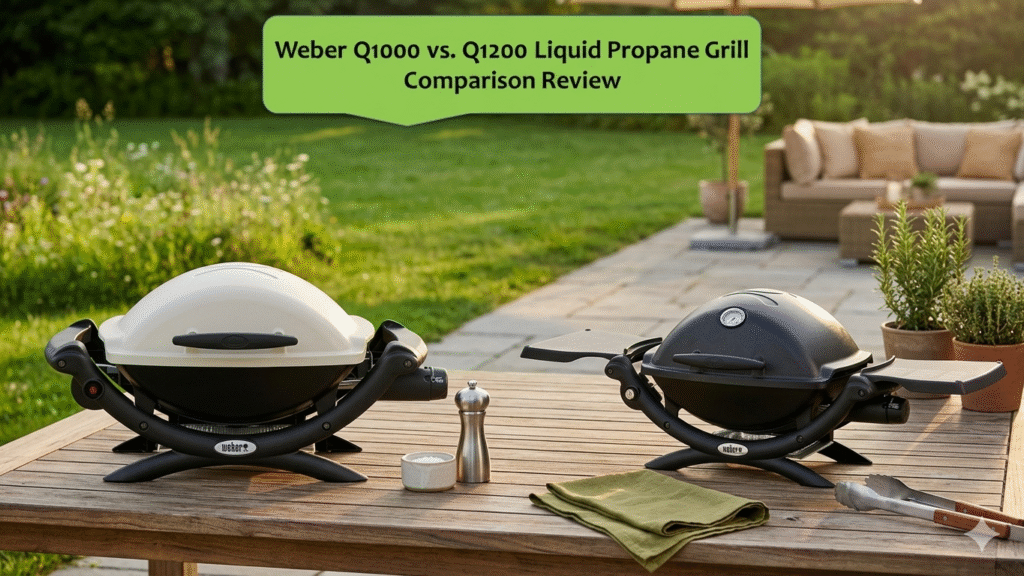
- The Weber Q1000 (The Lightweight Minimalist) is designed for maximum simplicity. It lacks side tables and a built-in thermometer. It uses a standard push-button piezo ignition. It’s built for the griller who wants the smallest possible storage footprint and doesn’t mind using a separate table for their prep work.
- The Weber Q1200 (The Feature-Rich Traveler) adds three major quality-of-life upgrades: two folding side tables, a lid-mounted thermometer, and a battery-powered electronic ignition. It also features a high-dome lid, which provides significantly more vertical clearance for bulky foods.
Essentially, the Q1000 is a “searing engine” in its purest form, while the Q1200 is a versatile “outdoor oven” that provides much more control over the cooking process.
Comparison Table: Weber Q1000 vs. Q1200 Propane Grill
| Feature | Weber Q1000 | Weber Q1200 |
| Cooking Area | 189 sq. in. | 189 sq. in. |
| Heat Output | 8,500 BTU/hour | 8,500 BTU/hour |
| Lid Profile | Standard | High-Dome |
| Ignition | Push-Button (Piezo) | Electronic (AA Battery) |
| Side Tables | None | 2 Folding Tables |
| Thermometer | No | Yes (Built-in) |
| Weight | 27 lbs | 31 lbs |
| Material | Cast Aluminum | Cast Aluminum |
| View Current Price On Amazon | View on Amazon | View on Amazon |
Detailed Comparative Review: The Griller’s Perspective
-
Design: The Battle of Footprint vs. Function
The Q1000 is a marvel of “toss-and-go” design. Because it doesn’t have side tables, it’s remarkably easy to slide into a tight spot in a packed SUV or a small storage locker. The chrome-finished lid looks classic, and the large, ergonomic side handles make it a breeze to carry from the parking lot to the picnic table. It feels rugged, with no moving parts to rattle during transport.
The Q1200, finished in a sleek Titanium, feels more like a premium appliance. The folding side tables are the most obvious upgrade, and I found them to be incredibly sturdy. They gave me a clean, dedicated space to set my seasonings and meat platters, which is a huge relief when you’re grilling at a park with limited table space. The high-dome lid on the Q1200 also gives the grill a more imposing stance and, as I found out, allows for much more creative cooking.
-
Ease of Use: Ignition and Heat Control
There is a distinct “quality of life” jump when you step up to the 1200’s controls.
- Ignition: The Q1000 uses a manual piezo igniter – you press the button, it clicks, and it sparks. It’s reliable but can be finicky in high wind. The Q1200 uses an electronic ignition that sparks rapidly as long as you hold the button. It lit on the first try every time I used it, even in a damp morning drizzle.
- Monitoring: This is the Q1200’s biggest advantage. With the built-in thermometer, I was able to dial in a perfect 350°F for chicken breasts without lifting the lid. On the Q1000, I had to “guess-timate” the heat based on the sound of the sizzle. Both grills use an infinite control burner valve, which offers much smoother temperature adjustments than a standard Low/Medium/High dial.
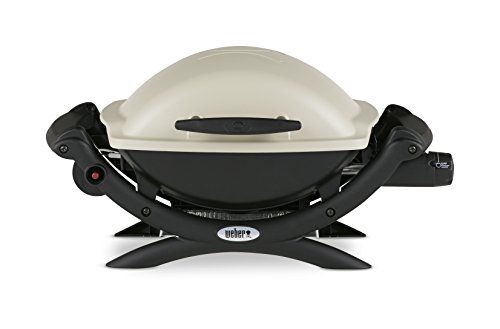
Weber Q1000 Liquid Propane Grill, Chrome
- One stainless steel burner produces 8500 BTU-per-hour to heat 189 square-inch total cooking area
- Porcelain-enameled cast-iron cooking grates and cast aluminum lid and body

Weber Q1200 Liquid Propane Portable Gas Grill, Black – 1‑Burner Travel and Camping Grill with Cast‑Iron Grates & Electronic Ignition…
- The Black Weber Q1200 Travel Grill features porcelain-enameled, cast-iron cooking grates; Grates offer superior heat retention, flavor infusion, and an attractive appearance as you elevate your grilling experience
- 8,500 BTU Burner: Provides robust level of heat output, making outdoor grill highly versatile; Suitable for high-heat searing and lower-temperatures; Fine-tune temperature to suit different cooking methods and foods with the infinite control burner
-
Functions: More Than Just Burgers
Both grills use the same porcelain-enameled cast-iron grates, which are the secret to their performance. They hold heat like a cast-iron skillet, allowing for a deep, professional sear even with a portable burner.
- Vertical Clearance: The high-dome lid on the Q1200 allowed me to roast a whole chicken using an indirect heat method (by placing the bird on a small roasting rack). This would have been impossible on the Q1000, where the lid would have rested directly on the food.
- The Griddle Factor: Both are compatible with the optional griddle insert. On the Q1200, I was able to make a full breakfast of bacon and eggs with the lid down, which helped the eggs cook evenly from the top. The Q1000 handles this well too, but you just have less “headroom” to work with.
-
Maintenance: Stress-Free Cleanup
Weber has mastered the art of the “clean cookbox.” Both models use a sloped floor that funnels grease into a removable catch pan at the bottom.
After a heavy session of bacon-wrapped jalapeño poppers, cleanup was a five-minute job on both. I simply swapped out the disposable aluminum drip pan and gave the cast aluminum body a quick wipe. Since both use cast aluminum lids, you don’t have to worry about paint peeling or rust spots forming after a rainy camping trip. The Q1200 tables are made of a durable nylon that wipes clean with a damp cloth, so they don’t add much to the maintenance routine.
Weber Q1000 (The Minimalist Master) Propane Grill
Weber Q1000 Liquid Propane Grill, Chrome
- One stainless steel burner produces 8500 BTU-per-hour to heat 189 square-inch total cooking area
- Porcelain-enameled cast-iron cooking grates and cast aluminum lid and body
Pros:
- Ultra-Portable: Fits in the smallest car trunks and lockers.
- Lightweight: Easy for one person to carry long distances.
- Reliable: Very few moving parts to wear out or break.
- Price: The most cost-effective way to get legendary Weber performance.
Cons:
- No Prep Space: You are always looking for a spot to set your tools.
- No Thermometer: Requires a separate meat probe for accurate roasting.
- Standard Lid: Can’t accommodate bulky items like a whole chicken.
Weber Q1200 (The Portable Patio Replacement) Propane Grill
Weber Q1200 Liquid Propane Portable Gas Grill, Black – 1‑Burner Travel and Camping Grill with Cast‑Iron Grates & Electronic Ignition…
- The Black Weber Q1200 Travel Grill features porcelain-enameled, cast-iron cooking grates; Grates offer superior heat retention, flavor infusion, and an attractive appearance as you elevate your grilling experience
- 8,500 BTU Burner: Provides robust level of heat output, making outdoor grill highly versatile; Suitable for high-heat searing and lower-temperatures; Fine-tune temperature to suit different cooking methods and foods with the infinite control burner
Pros:
- Side Tables: Integrated workspace is a game-changer at a campsite.
- Precision: Lid thermometer allows for “set and forget” roasting.
- High-Dome: Provides enough space for roasts and whole birds.
- Electronic Ignition: More reliable starts in windy or humid weather.
Cons:
- Wider: Requires more space on the table when in use.
- Slightly Heavier: A few extra pounds of weight to manage.
- Battery: The ignition requires a fresh AA battery to function.
The Verdict: My Final Recommendation
After months of back-to-back testing, the choice depends on your Mobility Needs vs. Cooking Ambitions.
I recommend the Weber Q1000 if: You are a solo traveler, a couple, or a tailgater who already has a well-equipped folding table at your site. If your goal is to have the most compact, “bulletproof” grill possible for searing steaks and burgers, the Q1000 is an incredible value. It delivers world-class heat in a tiny package.
I recommend the Weber Q1200 if: You want a “real” grilling experience on the road. If you find yourself frustrated by not having a place to set your seasonings, or if you want to experiment with roasting and baking away from home, the Q1200 is worth every extra dollar. The thermometer and side tables transform it from a “cooker” into a “kitchen.”
My Personal Choice: I am sticking with the Weber Q1200. For my style of weekend camping, having those side tables to hold my tools and a thermometer to ensure I don’t overcook my salmon is a luxury I’m willing to carry the extra weight for.
Frequently Asked Questions
-
Can I use a 20lb propane tank with these?
Absolutely. Both models are designed for the 1lb disposable cylinders, but you can purchase an LP Adapter Hose to connect to a standard 20lb tank. This is much more economical for home or long-term camping use.
-
Is the Q1200’s lid really that much taller?
Yes, the “high-dome” design adds about 1.5 inches of vertical clearance. It doesn’t sound like much, but it’s the difference between being able to fit a small whole chicken and having the lid rest on top of it.
-
Are the grates easy to clean?
Yes. The porcelain enamel protects the cast iron from rust and makes it relatively non-stick. Just use a stainless steel grill brush while the grates are hot, and they will stay in great shape for years.
-
Do they come with a stand?
No, both are tabletop models. However, they are both compatible with the Weber Portable Cart, which is a collapsible stand that makes them much easier to use at the beach or in a parking lot.
-
Can I bake a pizza on these?
You can! Because of the cast-iron grates and the lid design, you can use a small pizza stone. The Q1200 is slightly better for this because the thermometer helps you ensure the grill is at the proper 450°F before you slide the pizza in.