There is a specific kind of freedom that comes with tossing a griddle into the trunk of a car and heading toward the mountains or the stadium parking lot. This February, I’ve been chasing that freedom by putting two of Blackstone’s most popular 17-inch units—the Blackstone 1971 Original and the Blackstone 1814—through a grueling series of roadside breakfasts and backyard smashburger sessions.
If you are looking at these two side-by-side, you might think you are seeing double. They both occupy that “goldilocks” zone of being small enough to carry with one hand but large enough to feed a family of four. However, after seasoning both plates and scraping off enough bacon grease to fuel a small ship, I’ve discovered that the differences aren’t just in the model numbers. One is a featherweight champion of pure portability, while the other feels like a heavy-duty station designed for those who want a bit more “heft” in their outdoor kitchen. If you’re torn between these two tabletop titans, here is my take from the front lines of the griddle.
The Key Difference: Weight, Build, and Hood Integration
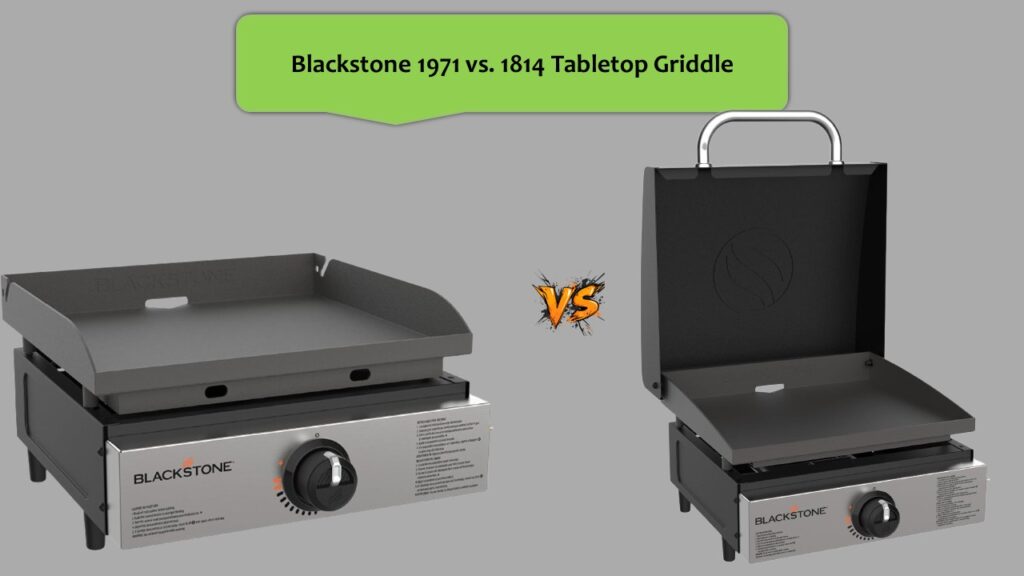
The fundamental difference between the Blackstone 1971 and the 1814 comes down to chassis weight and included components. The Blackstone 1971 is the “Original” ultra-lightweight model, weighing in at a mere 17.5 pounds, making it the ultimate choice for hikers and solo campers.
The Blackstone 1814, while also a 17-inch unit, is a much beefier version weighing 35.2 pounds—exactly double the weight of the 1971. This added weight in the 1814 is due to a more robust frame and the inclusion of a stainless steel hood, which allows for steaming and better heat retention, a feature notably absent from the base 1971 model.
Comparison Table: Blackstone 1971 vs. 1814
| Feature | Blackstone 1971 (Original) | Blackstone 1814 (Heavy Duty) |
| Cooking Surface | 267 sq. in. | 268 sq. in. |
| Item Weight | 17.5 lbs (Ultra-Light) | 35.2 lbs (Heavy Duty) |
| Heat Output | 12,500 BTUs | 12,000 BTUs |
| Lid/Hood | None (Open Top) | Included Stainless Steel Hood |
| Burner Style | H-Style Burner | H-Style Burner |
| Ignition | Piezo Push-and-Turn | Built-in Igniter |
| Material | Carbon Steel Top / Stainless Front | Stainless Steel / Carbon Steel |
| Dimensions | 17.3″D x 21.7″W x 8.6″H | 21.7″D x 20.5″W x 14.7″H |
| View Current Price on Amazon | View on Amazon | View on Amazon |
Detailed Comparative Review: My First-Person Griddle Test
I spent a weekend camping with the 1971 and a Tuesday night on the patio with the 1814 to see how that 100% weight difference actually impacts the cooking experience.
Design: The Sprinter vs. The Weightlifter
Holding the Blackstone 1971 feels almost like holding a heavy briefcase. At 17.5 pounds, I could carry it from the garage to the car with one hand while holding a cooler in the other. It’s remarkably low-profile (only 8.6 inches high), which makes it a dream for packing into a crowded trunk. The stainless steel front plate gives it a clean, modern look that doesn’t scream “cheap portable.”
The Blackstone 1814 feels like a “real” piece of kitchen equipment. It’s significantly taller and much heavier. When I set it on a plastic folding table, I felt the need to check the table’s weight limit. However, that extra weight translates to stability. The 1814 doesn’t slide around when you are vigorously scraping the surface with a metal spatula. Plus, the integrated hood on the 1814 is a game-changer for windy days, acting as a shield for the flame.
Ease of Use: Ignition and Heat Control
Both units utilize an H-style burner, which is the secret sauce of the Blackstone portable line. It ensures that the heat isn’t just a “hot spot” in the middle, but radiates out to the edges.
On the 1971, the Piezo ignition worked on the first click every single time. It feels very analog and reliable. On the 1814, the built-in igniter is smooth, and the heat intensity felt a bit easier to “fine-tune.” However, because the 1971 is an open-top design, I found that I lost more heat to the atmosphere. The 1814, with its lid, reached cooking temperature noticeably faster and stayed there, even when I was cooking in the shade during a breezy afternoon.
Functions: The Power of the Hood
When it came time to melt cheese on my burgers, the 1814 won by a landslide. With the hood, I just closed the lid for 30 seconds and the cheese was perfectly gooey. On the 1971, I had to use a separate basting cover (a metal dome) to get the same effect.
Both griddles provide roughly 267-268 square inches of space. To put that in “real world” terms, I was able to fit 9 large pancakes on both units at once. For a family of four, this is plenty of space for a full breakfast of eggs, bacon, and hash browns. The 12,000 to 12,500 BTUs on these small surfaces is actually quite powerful—I rarely had to turn either unit past “medium” to get a perfect sear.
Maintenance: Rear Grease Management
Blackstone has finally standardized their Rear Grease Management System, and thank goodness for that. Both models feature a hole at the back of the griddle plate where grease funnels into a small cup.
In my experience, the 1971 was slightly easier to wipe down because there are fewer “nooks and crannies” for grease to hide in. The 1814, with its hood hinges and taller frame, required a bit more detail work to keep the stainless steel looking pristine. However, both plates are made of heavy-duty carbon steel, which, once seasoned, becomes a beautiful non-stick surface that only requires a quick scrape and a light coat of oil after each use.
Blackstone 1971 Tabletop Griddle
Pros:
- Ultra-Portable: At 17.5 lbs, it is the king of “on-the-go” griddling.
- Compact: Fits in the smallest car trunks and storage bins.
- Simplicity: No hood hinges or extra bulk to deal with.
- Even Heat: The H-burner performs flawlessly for such a lightweight unit.
Cons:
- No Hood: Requires extra accessories for steaming or melting cheese.
- Wind Sensitivity: Flame can be more easily affected by heavy gusts.
- Lightweight Stability: Can shift slightly on the table if you’re scraping hard.
Blackstone 1814 Tabletop Griddle
Pros:
- Integrated Hood: Protects the surface, retains heat, and melts cheese instantly.
- Heavy-Duty Build: Feels more stable and durable for long-term use.
- Heat Retention: The taller frame and lid keep the cooking surface hotter in cold weather.
- Professional Feel: Looks and performs like a miniature version of the 36-inch pro models.
Cons:
- Heavy: At 35.2 lbs, it’s a bit of a workout to carry long distances.
- Larger Footprint: Takes up more vertical space in storage.
- Price: Generally carries a higher price tag due to the hood and extra steel.
The Final Recommendation: Which Griddle Should You Pack?
After a month of sizzling bacon and scraping steel, I’ve found that the “best” model depends entirely on how far you have to carry it.
I recommend the Blackstone 1971 if you are a true nomad. If you are a solo camper, a hunter, or someone who frequently picnics in spots that require a bit of a hike from the car, the 17.5-pound weight is unbeatable. It is the purest expression of a “griddle on the go.”

Blackstone 1971 Original 17" Omnivore Tabletop Griddle, Black | Stainless Steel Front Plate, Powder Coated Steel, Piezo Ignition
- Griddle on the Go: Bring this Blackstone 17-inch tabletop griddle on your next camping, hunting, or tailgating adventure to make meals on the go. This griddle is a portable cooking station with its lightweight, carry-friendly design
- Surprisingly Spacious Cooking Surface: Cook a wide variety of foods for every meal on this versatile griddle top. With 267 square inches of cooking space, this griddle cooks enough to feed up to 2-4 people while also being compact and portable
I recommend the Blackstone 1814 if your griddling mostly happens near the car or on a permanent tabletop. The stainless steel hood and the added stability make it a much more versatile cooking station. If you don’t mind the extra weight, the cooking experience is significantly improved by having that lid to trap heat and protect against the wind.

Blackstone® 1814 Propane Gas Griddle, 17 Inch, Black | Blackstone® 1814 Stainless Steel, Portable Flat Top, Heavy Duty, For Kitchen,…
- OUTDOOR ADVENTURE COOKING: Blackstone griddle works well for the backyard or the great outdoors, this flat top griddle makes cooking on-the-go easy. It can be used to make everything from scrambled eggs and pancakes to bacon and hamburgers
- PORTABLE CONVENIENCE: Take your grilling experience beyond your backyard because our tabletop griddle is compact and lightweight enough to be taken anywhere. Measuring just 17.5" L x 8.5" H x 18" W inches, it easily fits in your car trunk for tailgating, camping, hiking and other outdoor activities
Personally, I would choose the Blackstone 1814. Even though it’s heavier, having the lid makes the cooking process so much more controlled, and I’m a sucker for a perfectly melted cheeseburger!
Frequently Asked Questions (FAQs)
Q: Can I use a large 20-lb propane tank with these?
A: Yes! While they are designed to run on 1-lb propane canisters for portability, you can buy an adapter hose to connect them to a standard 20-lb tank for longer sessions.
Q: Do I need to season the griddle before the first use?
A: Absolutely. Both units come with a rolled steel top that needs to be seasoned with oil (I recommend Blackstone Seasoning or Flaxseed oil) 3 to 5 times before your first cook to create that black, non-stick surface.
Q: Can these be used indoors?
A: No. These are gas-powered outdoor appliances. They produce carbon monoxide and should only be used in well-ventilated outdoor areas.
Q: How many burgers can I fit on a 17-inch griddle?
A: You can comfortably fit 9 burgers made with a standard press. It’s perfect for a family of four.
Q: Is the 1814 hood removable?
A: It is attached via hinges, but you can unscrew it if you really need to. However, it’s designed to stay on as part of the unit’s thermal system.