Picture this: it’s a crisp Saturday afternoon, and you’ve got a prime brisket that’s been bathing in a dry rub for twelve hours. You’re standing in your backyard, staring at two nearly identical silhouettes of steel and smoke. One is a rugged, old-school legend that helped build the pellet grill empire; the other is a Wi-Fi-enabled, app-driven evolution of that same machine.
I’ve spent the last few months smelling like hickory and cherry wood while putting the Traeger Pro Series 22 and the Traeger Pro 575 through a backyard gauntlet. From low-and-slow overnight pork butts to high-heat Sunday chicken wings, I wanted to see if the “WiFIRE” lifestyle actually makes for better BBQ, or if the classic “set it and forget it” mechanical dial is still the king of the patio. If you’re torn between saving some cash for meat with the Pro 22 or splurging on the tech-heavy 575, here is my hands-on take from the smoke-filled trenches.
The Key Difference: WiFIRE and the D2 Drivetrain
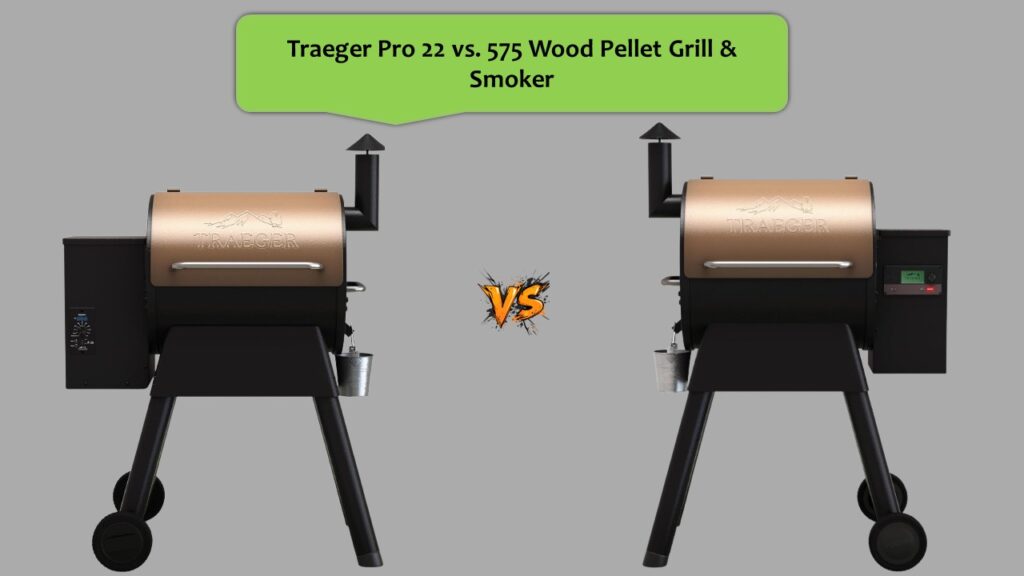
The fundamental difference between the Traeger Pro 22 and the Pro 575 is the technology driving the heat. The Traeger Pro 575 features the D2 Direct Drive drivetrain, which uses a brushless motor and a variable-speed auger for faster startup and more precise temperature maintenance.
It also includes WiFIRE technology, allowing you to monitor and control the grill via a smartphone app. The Pro 22 uses the older, reliable Digital Pro Controller with a standard AC motor. Additionally, the Pro 575 can reach a max temperature of 500°F, whereas the Pro 22 tops out at 450°F.
Comparison Table: Traeger Pro 22 vs. Pro 575
| Feature | Traeger Pro 22 | Traeger Pro 575 |
| Controller | Digital Pro Controller | D2 Smart Controller |
| Connectivity | None (Manual) | WiFIRE (Wi-Fi App Enabled) |
| Max Temperature | 450°F | 500°F |
| Drivetrain | Standard AC Motor | D2 Direct Drive (Brushless) |
| Cooking Space | 572 sq. in. | 575 sq. in. |
| Hopper Capacity | 18 lbs | 18 lbs |
| Startup Speed | Standard | TurboTemp (Fast Startup) |
| Weight | 125.44 lbs | 124 lbs |
| Price Point | Entry-Level Professional | Mid-Range Smart Grill |
| View Current Price on Amazon | View on Amazon | View on Amazon |
Detailed Comparative Review: My Experience on the Patio
I treated these grills like a professional pitmaster would—which means I ignored the weather and pushed them to their limits.
Design: Sawhorse Toughness and Subtle Refinements
Both grills share the “Sawhorse” chassis, which I’ve always appreciated. It feels incredibly stable. If you’ve ever tried to move a cheaper grill across a patch of grass or gravel, you know that flimsy legs are the enemy. Both the Pro 22 and 575 feel like they could survive a minor earthquake.
The Pro 22 (Bronze) has that classic, vintage BBQ look. The bronze lid is a nice touch that hides smoke stains better than the Pro 575’s Black finish. However, the 575 is slightly taller (53 inches vs 49 inches), which I found more comfortable for my back during long sessions of flipping burgers. The 575 also feels a bit “sleeker” because the WiFIRE antenna is tucked away, and the digital screen is much more modern and easier to read in direct sunlight.
Ease of Use: The App vs. The Dial
This is where the two grills diverge completely. With the Pro 22, you walk out, prime the pot, turn the dial to “Smoke,” and then set your temp. It’s mechanical. It’s tactile. But it also means you’re tethered to the backyard. I spent my Pro 22 cooks constantly peeking through the kitchen window to check the temp.
The Pro 575 changed the way I spend my Saturdays. Setting up the WiFIRE was surprisingly easy, and once it was connected, I could adjust the grill temperature while I was at the grocery store picking up more beer. The D2 Controller also features TurboTemp, which I tested side-by-side. The 575 reached 350°F nearly five minutes faster than the Pro 22. When you’re hungry and the kids are complaining, those five minutes feel like an hour.
Functions: Searing and Smoking
Both grills offer 6-in-1 versatility (Grill, Smoke, Bake, Roast, Braise, BBQ), but the Pro 575 has a higher ceiling. That extra 50°F (topping out at 500°F) makes a legitimate difference when you’re trying to get a char on a steak. The Pro 22’s 450°F is “fine,” but it’s more of a baking temperature than a searing one.
In terms of smoke quality, I noticed the D2 Drivetrain in the 575 is much quieter. The brushless motor doesn’t have that “groan” that the older AC motors in the Pro 22 sometimes make when the auger is under pressure. The 575 also seemed to recover its temperature much faster after I opened the lid to spritz my ribs. The Pro 22 had a bit more “swing”—sometimes as much as 15 degrees in either direction—while the 575 stayed remarkably locked in.
Maintenance: Hopper Cleans and Grease Management
Maintenance is largely identical, which is a good thing. Both have the Hopper Clean-out, which is my favorite Traeger feature. It allows you to toggle between Apple wood for pork and Mesquite for beef in about thirty seconds.
The porcelain-coated grates on both models are easy to scrub, but I did notice that because the Pro 575 runs hotter, I had to be more diligent about cleaning the drip tray liners to prevent grease fires during high-heat cooks. The Pro 22, running a bit cooler, was slightly more forgiving of a “lazy cleaner” like me.
Traeger Pro 22 Wood Pellet Grill & Smoker
Pros:
- Reliability: Fewer electronics means fewer things can go wrong over ten years.
- Affordability: The best way to get Traeger quality on a budget.
- Classic Look: The bronze finish is iconic and durable.
- Simplicity: No Wi-Fi passwords or app updates; just turn the dial and cook.
Cons:
- Temperature Swings: Less precise than the newer D2 models.
- Slower Startup: Takes longer to reach cooking temperature.
- No Remote Monitoring: You have to be physically present to check the meat probe.
Traeger Pro 575 Wood Pellet Grill & Smoker
Pros:
- WiFIRE Tech: Total control from your phone is a game-changer for long smokes.
- D2 Drivetrain: Faster, quieter, and much more precise temperature control.
- 500°F Max Temp: Better for searing and high-heat roasting.
- TurboTemp: Gets you cooking faster with improved recovery times.
Cons:
- Price: A significant jump in cost for the added technology.
- Tech Dependent: If your Wi-Fi is spotty in the backyard, you lose half the benefits.
- Black Finish: Shows water spots and grease streaks more easily.
The Final Recommendation: Which Pitmaster Are You?
After burning through bags of pellets in both machines, I’ve realized that the “best” grill depends on how much you value your time away from the patio.
I recommend the Traeger Pro 22 if you are a traditionalist who enjoys the “act” of grilling. If you’re usually within twenty feet of your grill anyway, and you don’t mind a slightly slower startup, the Pro 22 produces the exact same wood-fired flavor as the more expensive models for hundreds of dollars less. It is a workhorse that will likely outlive its more high-tech counterparts.

Traeger Pro 22 Wood Pellet Grill & Smoker, 572 Sq In | 6-in-1 BBQ versatility, meat probe, 450°F max, 18…
- 6-in-1 Versatility: The Traeger Pro 22 is the original wood pellet smoker and grill combo trusted by. Grill, smoke, bake, roast, braise, and BBQ. Enjoy authentic wood-fired flavor in every meal using this pellet grill built for all your outdoor cooking needs.
- Precise Temperature Control: Achieve consistent results with this electric smoker grill advanced Digital Pro Controller's advanced temperature control system. Grill hot and fast or low and slow from 180°F to 450°F within plus /- 15 degrees for unbeatable BBQ and smoking performance.
I recommend the Traeger Pro 575 if you are a busy person who loves BBQ but hates “babysitting.” The WiFIRE app is not a gimmick; it is a massive utility that allows you to live your life while the brisket does its thing. The D2 Drivetrain provides a level of precision that makes it almost impossible to mess up a cook.

Traeger Grills Pro 575 Wood Pellet Grill & Smoker with Wifi, App-Enabled, Bronze
- WiFIRE Technology for Remote Control: Monitor and control your electric smoker and grill from anywhere using the Traeger phone app. Adjust temps, set timers, and receive alerts with smart home connectivity for seamless outdoor grilling.
- Included Meat Probe and All-Terrain Mobility: Monitor internal food temps without lifting the lid of your Traeger smoker grill using the integrated meat probe. Durable wheels and sawhorse chassis provide stability and portability for your outdoor grilling setup.
For my money, the Traeger Pro 575 is the winner. The peace of mind I get from being able to check my meat probe temperature while I’m on the couch watching the game is worth every extra penny.
Frequently Asked Questions (FAQs)
Q: Can I use other brands of pellets in these grills?
A: You can, but Traeger recommends their own. I’ve found that using high-quality, 100% hardwood pellets is key to preventing auger jams. Cheaper pellets with lots of fillers tend to create more ash and can struggle in the Pro 22’s older motor.
Q: Is the Pro 575 actually bigger than the 22?
A: By only 3 square inches! The “22” in Pro 22 refers to the approximate width of the barrel, while “575” refers to the total square inches of cooking space. They effectively hold the same amount of food (about 24 burgers).
Q: Do I need a special cover for these?
A: Yes. These are electric grills with internal computers. While the steel is durable, you do not want water getting into the pellet hopper or the controller. Invest in the heavy-duty Traeger cover immediately.
Q: Can the Pro 575 run on 5G Wi-Fi?
A: Most WiFIRE controllers require a 2.4GHz Wi-Fi signal because it has a longer range and passes through exterior walls better than 5GHz. You may need to adjust your router settings if you have a dual-band system.
Q: How long does an 18lb hopper last?
A: On a “low and slow” smoke (225°F), you can usually get about 15–20 hours of cook time. If you’re cranking it to 450°F or 500°F, you’ll burn through a hopper much faster—potentially in 4–6 hours.