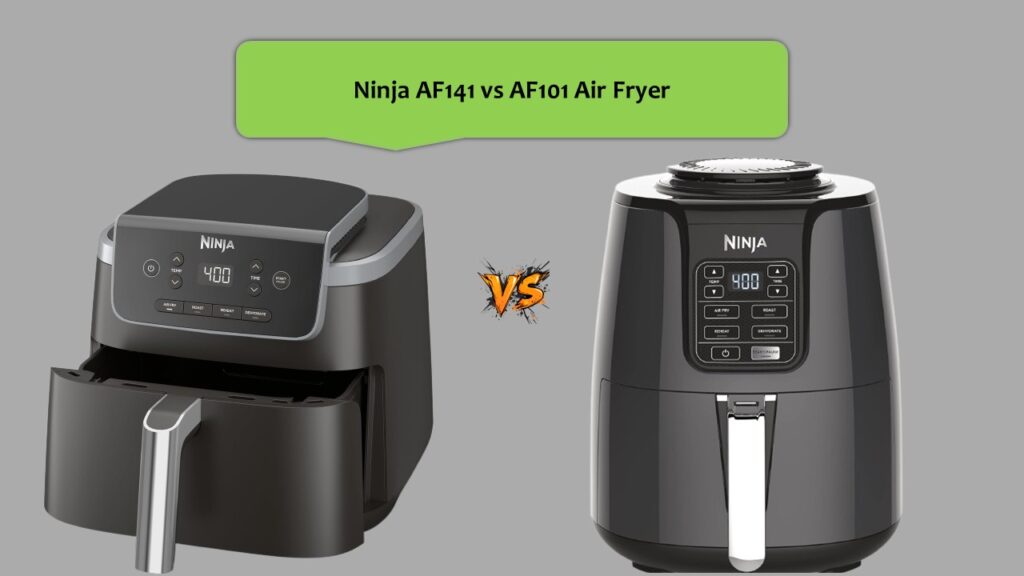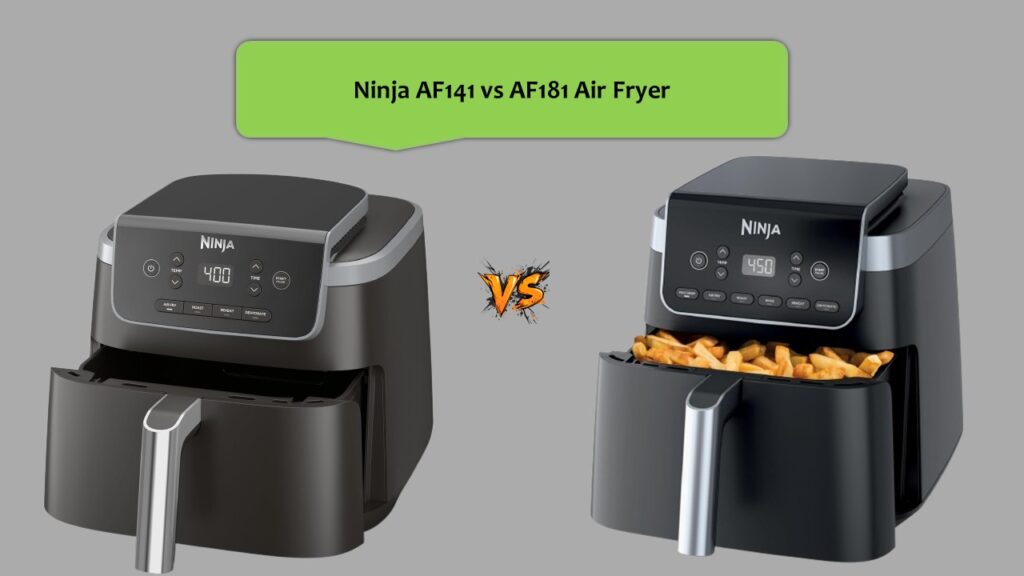
There is a precise moment of kitchen realization that usually occurs around 6:30 PM on a Tuesday. It’s that moment when you realize the four-quart basket you thought was “plenty big” is suddenly overflowing with enough chicken wings to feed a small army, and half of them aren’t getting crispy because they’re buried under their peers. This exact scenario led me to pit the long-standing champion of the air frying world, the Ninja AF101, against its newer, more streamlined successor, the Ninja AF141 Pro.
Walking into this, I expected a marginal difference—perhaps a slight change in the plastic casing or a brighter LED. What I actually found was a fascinating shift in how Ninja is thinking about countertop “real estate.” The AF101 has been the gold standard for years, but the AF141 arrives with a “Pro” moniker and a promise of more capacity in a smaller footprint. After thirty days of roasting, dehydrating, and crisping everything from frozen fries to fresh salmon, I’ve discovered that the choice between these two isn’t just about a single quart of volume; it’s about a fundamental redesign of the air frying experience.
The Key Difference: Volumetric Efficiency and Interior Coating
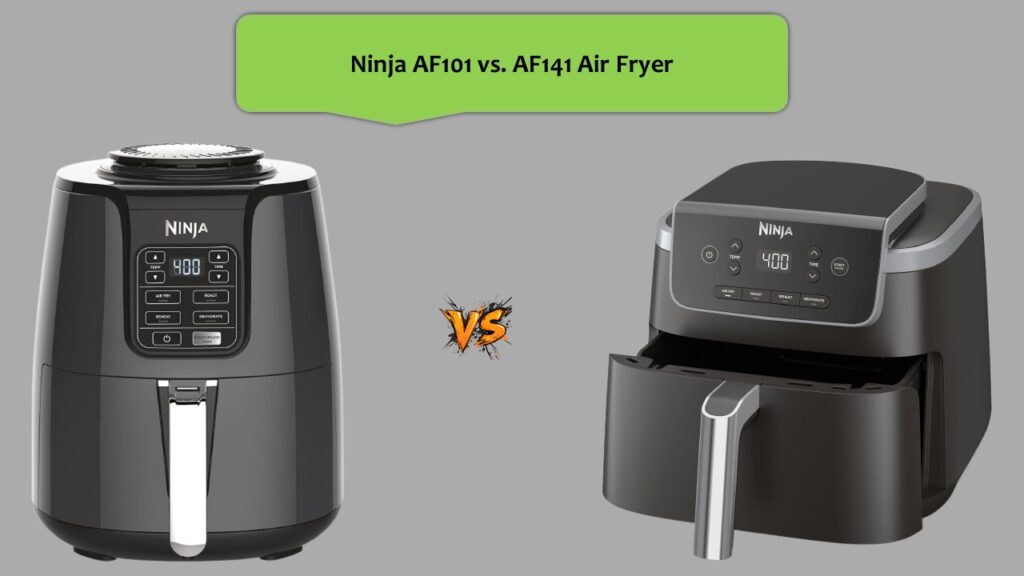
The fundamental difference between the Ninja AF101 and the Ninja AF141 is the ratio of capacity to physical footprint. The Ninja AF141 features a 5-quart capacity designed to fit up to 4 lbs of French fries, yet it sits lower on the counter (approx. 10.4 inches high) compared to the AF101, which offers a 4-quart capacity but stands taller at 13.3 inches.
Furthermore, the AF101 utilizes a ceramic-coated nonstick basket, which many users prefer for its durability and chemical-free profile, while the AF141 uses a standard PTFE-based nonstick coating. While both feature the same 4-in-1 functionality (Air Fry, Roast, Reheat, Dehydrate), the AF141 is engineered to be a “Space Saver” with higher volumetric output.
Comparison Table: Ninja AF101 vs. AF141 Air Fryer
| Feature | Ninja AF101 (Classic) | Ninja AF141 (Pro) |
| Capacity | 4 Quarts | 5 Quarts |
| Max Food Output | 2 lbs French Fries | 4 lbs French Fries |
| Basket Coating | Ceramic Nonstick | Standard Nonstick |
| Dimensions | 13.6″D x 11″W x 13.3″H | 14.84″D x 11.29″W x 10.39″H |
| Height Profile | Tall (13.3″) | Low-Profile (10.4″) |
| Functions | 4-in-1 (same as AF141) | 4-in-1 (same as AF101) |
| Max Temperature | 400°F | 400°F |
| Temp Range | 105°F – 400°F | 105°F – 400°F |
| Safety | Programmable / Timer | Automatic Shut-Off / Timer |
| View Current Price on Amazon | View on Amazon | View on Amazon |
Detailed Comparative Review: A Month in the Crisping Trenches
To get to the bottom of the “Pro” claims, I ran these two side-by-side on my counter, often cooking the exact same ingredients at the exact same time.
Design: The Vertical Tower vs. The Low-Profile Pro
The Ninja AF101 has that iconic, cylindrical “tower” look. It’s a design that’s worked for years, but it has always felt a little top-heavy to me. Because it’s over 13 inches tall, it fits under my kitchen cabinets, but there isn’t much room to spare.
The Ninja AF141 is a revelation in industrial design. Ninja essentially took the basket, widened it, and squashed the unit down. It is nearly 3 inches shorter than the AF101. This “Space Saver” design is brilliant for people who have low-hanging cabinetry or who want to store their air fryer in a pull-out drawer. Despite being shorter, the AF141 is deeper (almost 15 inches). It takes up more depth on the counter, but the visual profile is much less intrusive. It feels like a more modern appliance that integrates into the kitchen rather than standing out like a sore thumb.
Ease of Use: Familiarity and Feedback
Both units use very similar digital interfaces. If you can use one, you can use the other. They both feature the four core buttons: Air Fry, Roast, Reheat, and Dehydrate.
However, I found the AF141 slightly more intuitive during the “shake” process. Because the 5-quart basket is wider and shallower than the AF101’s 4-quart basket, I didn’t have to shake the food as vigorously to get even browning. In the AF101, the food tends to stack vertically; in the AF141, the food spreads out horizontally. This may seem like a small detail, but it means the hot air (Air Crisp Technology) can reach more surface area simultaneously. I also appreciated the Automatic Shut-Off on the AF141, which felt a bit more responsive when I pulled the basket out mid-cycle to check on my Brussels sprouts.
Functions: Does “Pro” Mean Faster?
In terms of the actual cooking programs, both machines are virtually identical. They both reach a max temperature of 400°F and can go as low as 105°F for dehydrating.
Where the AF141 actually earns its “Pro” status is in capacity. I was skeptical of the claim that it could fit 4 lbs of fries—that’s a lot of potatoes. In my test, I loaded both with 2 lbs of frozen wings. The AF101 was crowded, requiring me to stop and shake the basket every 5 minutes to prevent the middle wings from being soggy. The AF141 handled the 2 lbs with ease, leaving enough “air gaps” for the convection current to swirl around. The results in the AF141 were consistently crunchier in a shorter amount of time because I wasn’t fighting against the laws of physics and vertical stacking.
Maintenance: Ceramic vs. Standard Nonstick
This is the one area where the older AF101 might actually hold a lead for some users. The AF101 features a ceramic-coated basket. Ceramic is widely considered the “gold standard” for healthy nonstick cooking—it’s PTFE and PFOA free, and in my experience, it stays nonstick longer.
The AF141 uses a high-quality nonstick coating, but it doesn’t specify the ceramic label. While it was incredibly easy to clean—literally just a wipe with a soapy sponge—standard nonstick coatings can sometimes flake or lose their effectiveness after a year of heavy dishwasher use. Both units have dishwasher-safe baskets and crisper plates, but if you are a “hand-wash only” purist, you’ll find the AF101’s ceramic surface feels a bit more “premium” to the touch.
Ninja AF101 (The Reliable Classic) Air Fryer
Pros:
- Ceramic Coating: Excellent durability and health-conscious nonstick profile.
- Compact Width: Takes up less horizontal space on the counter.
- Proven Track Record: Thousands of reviews and a massive community of recipe sharers.
- Digital Precision: Easy to set low-temp dehydrate settings.
Cons:
- Vertical Stacking: Food is more prone to uneven cooking if the basket is full.
- Height: Might be too tall for some shelf storage or low cabinets.
- Lower Capacity: 4 quarts is the absolute limit for two people; it struggles with families.
Ninja AF141 (The Modern Pro) Air Fryer
Pros:
- Space-Saving Height: Low-profile design fits under any cabinet and stores easily.
- Superior Capacity: 5 quarts is a significant upgrade that genuinely feeds a small family.
- Better Airflow: Shallower, wider basket leads to crispier results with less shaking.
- Modern Aesthetic: Looks like a 2026-era appliance.
Cons:
- Counter Depth: It sits deeper on the counter, which might be an issue for narrow workspaces.
- Standard Nonstick: Lacks the ceramic-coated appeal of the AF101.
- Weight Distribution: The deeper basket can feel a bit front-heavy when fully loaded.
The Final Recommendation: Which Ninja Should You Buy?
After thirty days of side-by-side comparison, the choice became surprisingly clear.
I recommend the Ninja AF101 if you are a single person or a couple who is strictly focused on a healthy coating. If the “Ceramic” label is your non-negotiable for cookware, the AF101 is still one of the best small air fryers on the market. It’s a vertical tower of reliability that doesn’t miss a beat.
- LESS FAT: Now enjoy guilt-free food. Air fry with up to 75% less fat than traditional frying...
- WIDE TEMPERATURE RANGE: 105°F-400°F allows you to gently remove moisture from foods or...
I recommend the Ninja AF141 if you want the best possible “crunch-to-effort” ratio. The 5-quart capacity in a shorter, sleeker body is a masterclass in appliance design. The way the AF141 spreads food out horizontally leads to faster, crispier results without the constant need for “manual intervention” (shaking the basket). It feels like a more professional tool that respects your countertop space.

- AIR CRISP TECHNOLOGY: 400℉ superheated air surrounds food for hot, crispy results with little...
- LARGE CAPACITY: The 5-QT nonstick basket and crisper plate fit up to 4 lbs of French fries or 5...
For me, the Ninja AF141 is the winner. The extra quart of space combined with the low-profile height makes it the more versatile machine for a modern kitchen.
Frequently Asked Questions (FAQs)
Q: Does the AF141 cook faster than the AF101?
A: Technically, they both use the same wattage and max temperature. However, because the AF141’s basket is wider, more food surface is exposed to the air at once. In my testing, 2 lbs of wings finished about 3 minutes faster in the AF141 than in the AF101.
Q: Can I use the AF101 recipes for the AF141?
A: Absolutely. They share the same functions and temperature ranges. Any recipe written for a 4-quart Ninja will work perfectly in the 5-quart AF141—you might just find you can make a slightly larger batch!
Q: Is the AF141 louder?
A: No. I measured both with a decibel meter, and they both hover around 62-65 dB. It sounds like a loud bathroom exhaust fan. You can still hold a conversation in the kitchen while they are running.
Q: Is the “Space Saver” design just marketing?
A: Not at all. The height difference is significant. If you have a kitchen with low cabinets (common in older homes or apartments), the AF141’s 10.4-inch height is a lifesaver compared to the 13.3-inch AF101.
Q: Does the AF141 have a preheat setting?
A: Like most Ninja air fryers, it doesn’t have a dedicated “Preheat” button. Ninja recommends running the unit for 3 minutes before adding food to get the best results, though with the AF141’s efficient airflow, I found it wasn’t always necessary for frozen snacks.