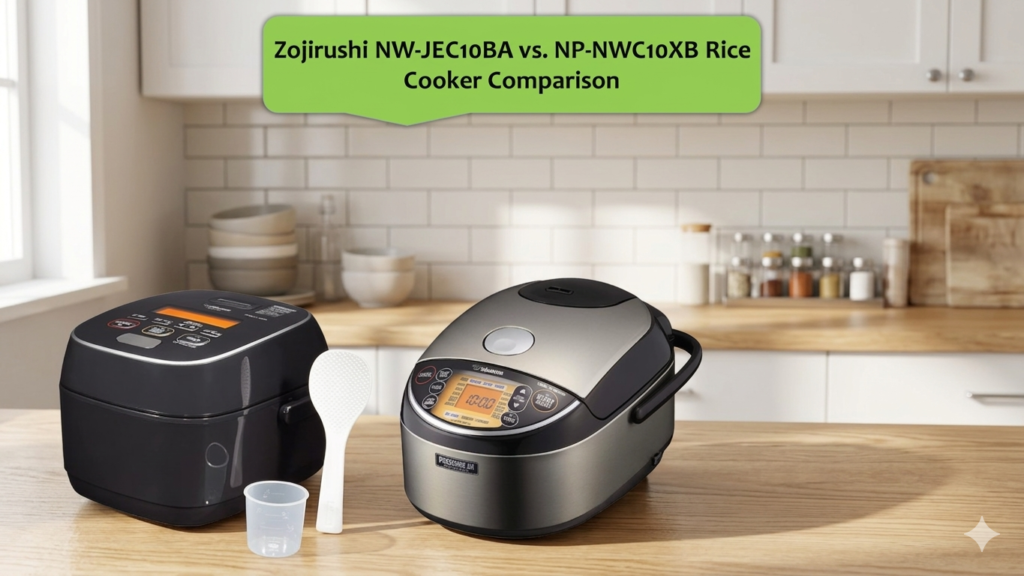
If you take your rice seriously, you eventually find yourself looking at the “Made in Japan” elite tier of kitchen appliances. I spent the last few months living with two of the most sophisticated machines ever designed for a grain of rice: the Zojirushi NW-JEC10BA and the Zojirushi NP-NWC10XB.
At this price point, you aren’t just buying a pot that boils water; you are investing in a pressurized induction system that uses Artificial Intelligence to manipulate the texture of your food. These machines use pressure to gelatinize starch, making rice sweeter, softer, and more consistent than any standard cooker. However, while they share the same core technology, they approach the “perfect bowl” from two different design philosophies.
The NW-JEC10BA is a sleek, space-saving evolution focused on texture customization, while the NP-NWC10XB is a robust, multi-grain powerhouse designed for a global pantry. After a season of cooking everything from sushi rice to steel-cut oatmeal, I’ve broken down exactly where these two heavyweights diverge.
The Key Difference: NW-JEC10BA vs. NP-NWC10XB Rice Cooker
The fundamental divide between the Zojirushi NW-JEC10BA and the NP-NWC10XB is Operational Control and Kitchen Footprint.
- The Zojirushi NW-JEC10BA (The Refined Specialist) is a compact, modern unit. It features an advanced pressure system with 4 distinct texture settings, allowing you to dial in the exact “bite” of your rice. It is significantly shorter and shallower than its counterpart, making it the superior choice for kitchens with limited counter space or low-hanging cabinets.
- The Zojirushi NP-NWC10XB (The Versatile Giant) is a larger, “Stainless Black” machine that prioritizes a wide array of grain-specific presets. While it uses an automatic 3-level pressure system, it stands out with dedicated buttons for Jasmine Rice, Congee, and Steel Cut Oatmeal. It is built for the cook who wants a pre-programmed solution for every type of grain imaginable.
In short, the NW-JEC10BA offers more refined control over the rice texture, while the NP-NWC10XB offers more pre-set variety for international grains.
Comparison Table: NW-JEC10BA vs. NP-NWC10XB Rice Cooker
| Feature | Zojirushi NW-JEC10BA | Zojirushi NP-NWC10XB |
| Heating Method | Pressure Induction (IH) | Pressure Induction (IH) |
| Logic | Advanced AI (Artificial Intelligence) | Advanced AI (Artificial Intelligence) |
| Pressure Tech | 4 Texture-Specific Settings | 3 Auto-Selected Levels |
| Finish | Sleek Black | Stainless Black |
| Special Menus | White, Umami, Brown, Sushi | Jasmine, Oatmeal, Congee, Brown |
| Spatula | Self-Standing (Hygienic) | Standard Non-Stick |
| Dimensions | 13.62″D x 10.75″W x 8.5″H | 16.5″D x 15.38″W x 10.13″H |
| Origin | Made in Japan | Made in Japan |
| View Current Price on Amazon | View on Amazon | View on Amazon |
Detailed Comparative Review: From the Kitchen Counter
-
Design: Modern Stealth vs. Premium Presence
The NW-JEC10BA is a marvel of spatial efficiency. At only 8.5 inches tall, it fits perfectly in my appliance garage. It has a minimalist, matte-black aesthetic that feels very “future-forward.” The build quality is dense and professional, and the buttons have a satisfying, high-end click.
The NP-NWC10XB is a much more commanding presence. Its depth of 16.5 inches means it took up nearly the entire width of my counter. However, the Stainless Black finish is truly stunning; it has a metallic sheen that hides fingerprints much better than plastic. The display is larger and easier to read from across the room, which I appreciated during busy dinner prep.

Zojirushi NW-JEC10BA Pressure Induction Heating (IH) Rice Cooker & Warmer, 5.5-Cup, Made in Japan
- Capacity Up to 5.5 cups uncooked rice / 1.0 liter
- Pressurized Cooking and Steaming: Promotes gelatinization and produces sticky and plump rice Automatically selects from 3 pressure levels according to the menu selected Utilizes 4 different pressure settings to perfect variety of textures Applies pressure at the end during steaming to burn off excess moisture for best cooking results

Zojirushi Np NWC10XB Pressure Ih Rice Cooker 5.5 Cup (Black) | Nonstick inner pan
- Pressurized Cooking and Steaming: Promotes gelatinization and produces sticky and plump rice
- AI (Artificial Intelligence): AI technology learns and adjusts the cooking cycle to get perfect results
-
Ease of Use: The “Smart” Cooking Experience
Both machines utilize Artificial Intelligence (AI) to monitor the internal temperature and the volume of rice. They literally “learn” your cooking habits and adjust the soak and steam times to ensure every batch is identical.
- NW-JEC10BA Utility: I found the texture customization to be the highlight here. If you like your white rice slightly firmer for stir-fry but “softer” for a side dish, you can toggle between settings easily. The self-standing spatula is a small but brilliant addition – it keeps the rice-contact surface off the counter, maintaining better hygiene.
- NP-NWC10XB Utility: This machine is a breakfast hero. Having a dedicated Steel Cut Oatmeal setting meant I could set a timer the night before and wake up to a pot of perfectly creamy oats that didn’t boil over. The Jasmine rice setting was equally impressive, managing to keep the long grains separate and aromatic without the “mush” often associated with pressure units.
-
Functions: The Science of Texture
Pressure Induction is the “gold standard” because it raises the boiling point, forcing moisture into the core of each grain for perfect gelatinization.
- NW-JEC10BA Performance: With 4 pressure levels, this machine is a brown rice specialist. I used the high-pressure setting, and the brown rice came out with a texture so soft it almost fooled my kids into thinking it was white rice. The machine also applies a burst of pressure at the end of the cycle to “burn off” excess moisture, leaving the rice fluffy and plump.
- NP-NWC10XB Performance: The Umami setting on this model is legendary. It extends the soaking time at a specific temperature to release natural sugars from the grain. The result is a bowl of rice that tastes noticeably sweeter and more complex than what you’d get from a standard IH cooker.
-
Maintenance: Built for Longevity
Since both are “Made in Japan” flagships, the maintenance is straightforward but requires consistency. Both feature a detachable stainless steel inner lid that houses the pressure regulator.
The NW-JEC10BA interior is flatter, which made it slightly easier for me to wipe down after a messy “mixed rice” session. The NP-NWC10XB, because of its stainless finish, requires a soft cloth to keep it looking pristine. Both machines use a high-quality non-stick inner pot that must be hand-washed. I’ve found that even after dozens of cooks, the starch simply rinses away under warm water.
Zojirushi NW-JEC10BA (The Refined Specialist) Rice Cooker
Zojirushi NW-JEC10BA Pressure Induction Heating (IH) Rice Cooker & Warmer, 5.5-Cup, Made in Japan
- Capacity Up to 5.5 cups uncooked rice / 1.0 liter
- Pressurized Cooking and Steaming: Promotes gelatinization and produces sticky and plump rice Automatically selects from 3 pressure levels according to the menu selected Utilizes 4 different pressure settings to perfect variety of textures Applies pressure at the end during steaming to burn off excess moisture for best cooking results
Pros:
- Space Saver: Significantly more compact than the NWC model.
- Texture Control: 4 pressure levels for ultimate “mouthfeel” customization.
- Hygienic Spatula: Self-standing design is a game-changer for cleanliness.
- Modern Aesthetic: Fits seamlessly into minimalist kitchens.
Cons:
- Fewer Presets: Requires manual adjustment for specialty grains like oatmeal.
- Lower Capacity for Height: The compact lid means less vertical “headroom.”
Zojirushi NP-NWC10XB (The Multi-Grain Master) Rice Cooker
Zojirushi Np NWC10XB Pressure Ih Rice Cooker 5.5 Cup (Black) | Nonstick inner pan
- Pressurized Cooking and Steaming: Promotes gelatinization and produces sticky and plump rice
- AI (Artificial Intelligence): AI technology learns and adjusts the cooking cycle to get perfect results
Pros:
- Menu Diversity: Dedicated buttons for Jasmine rice, Congee, and Oatmeal.
- Umami Setting: Superior flavor extraction for white rice.
- Large Display: High-contrast screen is very easy to read.
- Premium Finish: Stainless Black is durable and elegant.
Cons:
- Massive Footprint: Takes up a lot of depth on your counter.
- Heavier: Not ideal if you plan to move the machine frequently.
The Verdict: Which Zojirushi Wins?
After months of back-to-back testing, the “best” model depends on your Pantry Variety vs. Counter Space.
I recommend the Zojirushi NW-JEC10BA if: You have a small kitchen or limited counter space. If you are a rice “connoisseur” who values the ability to fine-tune the texture (firm vs. soft) of your short-grain and brown rice, this is the most sophisticated, compact machine on the market. It is the perfect choice for a modern, efficient kitchen.
I recommend the Zojirushi NP-NWC10XB if: You want a machine that does it all. If you regularly cook Jasmine rice, steel-cut oats, and porridge, the dedicated presets on the NWC10XB will make your life significantly easier. It is a large, beautiful appliance that acts as a true multi-grain station.
My Personal Choice: I prefer the Zojirushi NW-JEC10BA. I value the extra counter space, and the 4-level pressure system gave me a level of control over my sushi rice that I haven’t found in any other machine.
Frequently Asked Questions
-
Does the pressure make the rice cook faster?
Actually, no. Both machines take about 50–60 minutes for a standard white rice cycle. The pressure is used to enhance the taste and texture of the rice, not to speed up the process. Both have a “Quick” mode for emergencies, but the texture isn’t quite as fluffy.
-
Can I cook regular rolled oats in the NP-NWC10XB?
It is specifically designed for Steel Cut Oatmeal. Rolled oats tend to create a starchy foam that can clog the pressure valve, which is a safety risk. Stick to steel-cut or follow the Congee settings for other grains.
-
Is the “Stainless Black” actual metal?
Yes, the NP-NWC10XB features a high-grade stainless steel exterior with a clear coating. It is much more durable than standard plastic and provides a very premium feel.
-
What is the “Made in Japan” advantage?
Zojirushi’s top-tier models (like these two) are manufactured in Japan with more rigorous quality control and higher-grade components. This usually includes more advanced AI chips and the platinum-infused non-stick coatings.
-
How long does the “Keep Warm” actually last?
Both machines feature an Extended Keep Warm mode. Thanks to the pressure lid and AI monitoring, I have kept rice for 24 hours and it still tasted freshly cooked, with no yellowing or drying out.